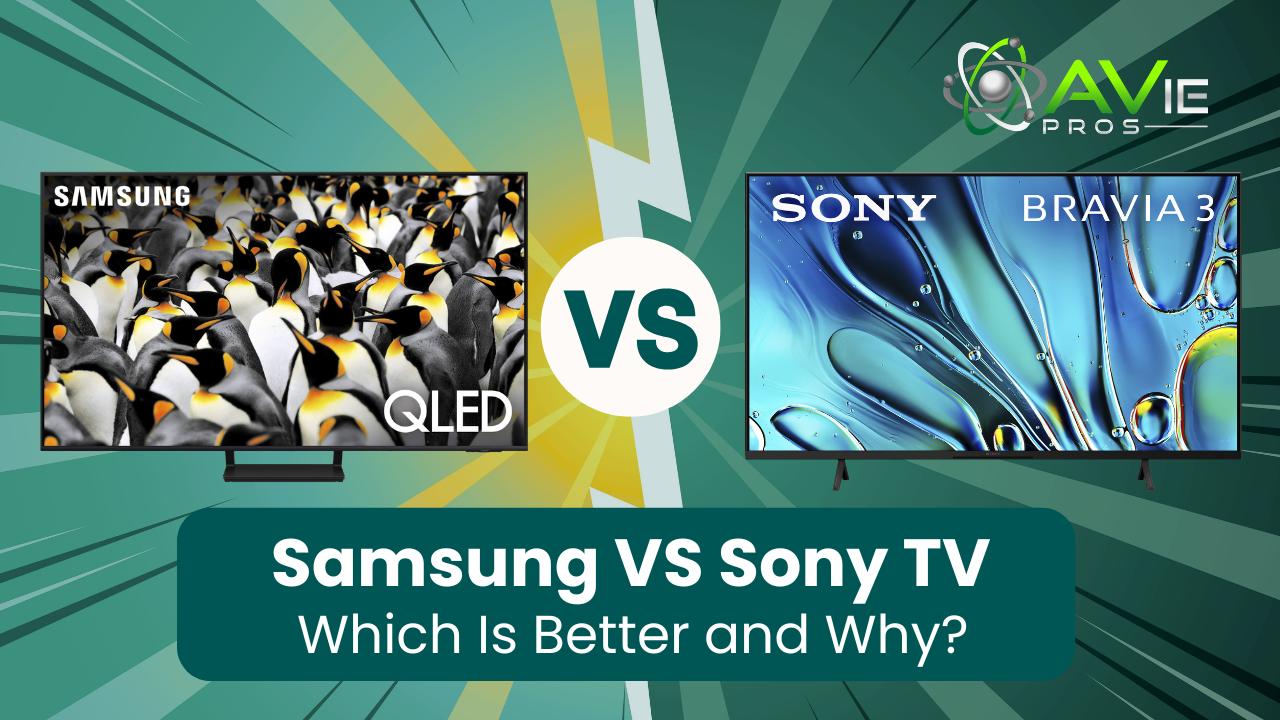
When people think about purchasing a new television, the comparison between Samsung and Sony TVs takes priority. Both companies have established an excellent track record in the TV industry and are highly well-liked worldwide. They offer modern technologies, stylish designs, and excellent image quality. People are commonly confused because both companies offer both expensive and reasonably priced TVs.
Price, durability, game possibilities, sound, and image quality all play a role in the decision between the two manufacturers. In order to help new customers understand which brand is better for them, we will go over all the important details simply in our detailed comparison of Samsung and Sony TVs. Let’s explore it:
Different Between Samsung & Sony TV
There are multiple facts that allow you to decide which one is the best choice according to your needs. It’s only possible through looking at its features in detail. Let’s have a look at both brand features and unlock an overall good option:
1. Brand History and Reputation
Understanding the history of both companies is important when comparing Samsung vs Sony TVs. The South Korean business Samsung has grown to become one of the biggest names in electronics worldwide. The company produces a range of screens, household appliances, and cell phones.
Sony is a Japanese business with a long history in the electronics and entertainment industries. Sony is also well-known for its audio equipment, game consoles, and cameras. Both brands have a good reputation and are respected. Sony is known for its natural picture quality, while Samsung is known for its creative and modern technology.
2. Design and Build Quality
One of the first things people look at when comparing Samsung and Sony TVs is design. Samsung TVs typically have modern designs and very small borders. The majority of Samsung TVs have a simple style that goes well with modern households. Samsung also places a high value on fashionable stands and simple borders.
While Sony TVs have beautiful designs, they usually place a greater value on durability and stability than on thinness. In general, Sony TVs feel strong and have excellent construction. Both brands provide high-quality products in terms of design and build. Samsung may have a small advantage if you’re searching for a sleek and stylish design.
3. Display Technology Differences
One of the most noticeable differences between Sony and Samsung TVs is display technology. The majority of Samsung TVs use QLED and Neo QLED display technology. Special layers are used in QLED displays to improve color accuracy and brightness. OLED and LED display technology are the pillars of Sony TVs.
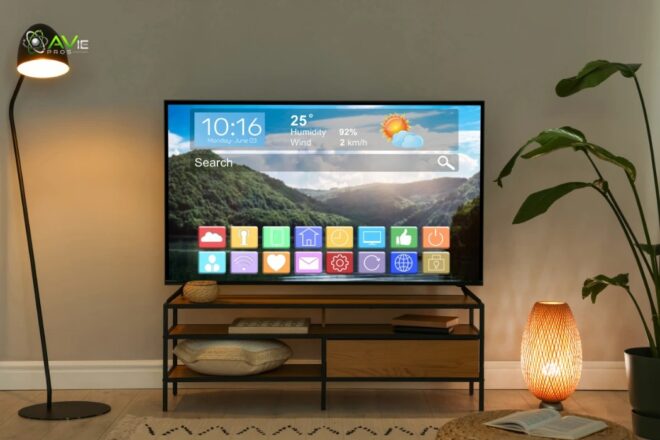
Because each pixel can be switched on and off separately, OLED displays are known for their deep blacks and high contrast ratios. If you want to use the TV in a bright room, Samsung TVs’ focus on high brightness is beneficial. High contrast and natural colors are the main features of Sony TVs. While both screens are excellent, your experience may vary slightly based on how you use them.
4. Picture Quality Comparison
When comparing Samsung vs Sony TVs, the picture quality is the most important feature. Samsung televisions are well-known for their bright pictures and brilliant displays. Because their screens are clear and visible, they perform best in well-lit environments. The natural colors of Sony TVs are well-known.
Many claim that Sony provides a more cinematic experience, particularly while watching movies. In order to give the scenery a smooth, detailed appearance, Sony is also developing the newest image processing technologies. In order to increase clarity, Samsung also uses strong processors. To put it briefly, Sony TVs will be more realistic, while Samsung TVs will be brighter and more colorful.
5. Brightness and Contrast Performance
The brightness and contrast ratio are important factors when comparing Samsung and Sony TVs. The brightness of the Samsung QLED TV is usually higher. For this reason, a room with lots of windows or strong lighting is always a smart choice. Glare and reflections are constantly reduced by the high brightness. Because the OLED pixels always switch off in a dark situation.
The Sony OLED TV always has deeper blacks than the Samsung QLED TV, even if it isn’t always as bright. This constantly enhances contrast and creates a stunning appearance for dark settings. Samsung always feels better if you watch TV in a bright environment during the day. Sony consistently offers better contrast performance if you choose to view movies in a poor lighting environment.
6. Smart TV Features and Interface
When comparing Samsung and Sony TVs, smart features are important. Tizen OS is the exclusive smart platform used by Samsung TVs. The interface is simple and smooth, and it’s easy to use. The apps load fast, and the menu system is simple. Google TV is the smart platform included with Sony TVs.
A wide range of Google ecosystem-based apps and services is accessible through Google TV. Voice search and the use of devices are features offered by Google TV. Popular streaming apps are compatible with both Sony and Samsung TVs. Sony’s Google TV is adaptable and integrated, whereas Samsung’s TV is smooth and simple.
7. Sound Quality Comparison
Sound quality is another important factor when comparing Samsung TV vs Sony TV. In general, Samsung TVs have good sound quality, and many of them have features that let you modify the sound to fit the room. However, Sony gets great reviews for the better speakers found in several of its models.
Sony TVs are known to place a high value on sound quality and may include sophisticated sound positioning technologies. Sony TV offers a slightly better sound experience without the need for any extra speakers, even though both of them advise using a soundbar for higher sound quality.
8. Gaming Performance and Features
When comparing Samsung TV with Sony TV, the gaming performance is an important factor for today’s user. Samsung TVs are known for their excellent support for high refresh rate gaming and their low input lag. A refresh rate of 120 Hz is supported by the Samsung TVs. Given that Sony also manufactures the PlayStation game system.
The Sony TVs also support the latest gaming capabilities. Sony TVs are designed with PlayStation games in mind. The latest versions of Sony and Samsung TVs both support HDMI 2.1. Samsung may perform slightly better if you’re a gamer looking for the lowest rate of delay, but Sony is also excellent.
9. Price and Value for Money
Price is one of the most important factors in the comparison of Samsung and Sony TVs. Samsung offers a range of TVs to fit various price points. Because of this, Samsung TVs are now available to a wider range of customers. Sony TVs are often a little more expensive, particularly the premium OLED models.
However, many customers believe that the higher picture processing and sound quality of the Sony TV make it worth the additional cost. The Samsung TV might be a better choice if you’re searching for a TV that is reasonably priced without sacrificing performance. Sony TV might be a fantastic option if you are prepared to spend more for a cinematic experience.
10. Durability and Long-Term Reliability
When comparing Samsung vs Sony TVs, durability is another important factor. Both companies are well-known for their reliable electronics. If properly maintained, Samsung TVs, which are commonly used, are known to last for many years. In addition, Sony TVs are renowned for their durability and stability.
Some believe that Samsung is more focused on innovation, and Sony TV is more focused on quality. In actuality, both companies are renowned for producing dependable electronics. The brand is less significant than the handling and installation done correctly. If properly maintained, both Sony and Samsung TVs can survive for many years without experiencing any issues.
11. Viewing Angles and Room Placement
Viewing angles are highly important when comparing Samsung and Sony TVs, especially if you have a large family or a large living room. The clarity of the image you see when sitting on the side instead of in front of the TV is known as the viewing angle.

When seen from a major angle, some Samsung LED and QLED TVs may lose some of their color fidelity, while the more expensive models perform better. Because each pixel generates its own light, Sony OLED TVs often have a wider viewing angle, ensuring that the colors remain correct no matter where you are watching.
12. Motion Handling and Sports Performance
Motion handling is another factor to consider when comparing the Samsung TV with the Sony TV, especially for sports fans. The motion in action films and sports like football and cricket must be managed carefully to avoid blurring. High refresh rates and motion handling capabilities are common in Samsung TVs, which guarantee that moving objects appear clean and smooth.
Because Sony TVs have advanced image processors, they are also well known for their remarkable motion handling capabilities. Customers have reported that Sony TVs handle motion pictures with ease and don’t make the scenes appear unreal. Both models are great if you love sports or action movies, but Sony TVs may be a little better at looking natural in fast motion.
13. Energy Efficiency and Power Consumption
When comparing Samsung and Sony TVs, the use of energy is typically ignored, but it is an important factor over time. While Samsung QLED TVs are often built to manage brightness well, excessive brightness levels can also result in high energy usage. Because the pixels on Sony OLED TVs are totally turned off while showing black.
They may consume less energy in areas with poor lighting. However, the screen’s size, brightness, and usage duration will all affect the overall energy usage. Both brands provide energy-saving modes and adhere to international energy standards.
14. Model Variety and Screen Size Options
The availability of model variations and screen sizes is another important factor to take seriously when comparing Samsung vs Sony TVs. From small, cheap displays to larger, premium panels, Samsung offers a fairly broad selection of devices. Customers can use this to choose a TV that suits their budget and room size. Samsung offers more alternatives in this regard.
But Sony TVs also come in a variety of screen sizes, particularly in the mid-range and premium markets. Samsung might be a better choice if you have more financial flexibility or are interested in larger screen sizes. However, both companies provide excellent large-screen TVs in the premium markets.
15. Customer Support and Warranty
An additional factor while choosing between Samsung and Sony TVs is customer service. Samsung has service facilities all around the world and broad international coverage. In many places, this guarantees that warranties and repairs are simpler to manage. In addition, although it might not be accessible in every country.
Sony offers international customer assistance. With one year for common issues, customer care for warranties is usually the same. There can be an extra cost for extended warranties. The quality and duration of customer service could be different by location. Both businesses make an effort to maintain client satisfaction, while Samsung might provide somewhat simpler access.
Final Samsung vs. Sony TV Decision
There is no easy solution to the Samsung vs. Sony TV comparison because each company has many advantages. Samsung is renowned for its affordable prices, gaming prowess, sleek designs, and amazing screens. Sony is renowned for its cinematic experience, strong contrast ratio, natural picture clarity, and good sound quality. What matters most to you will determine everything.
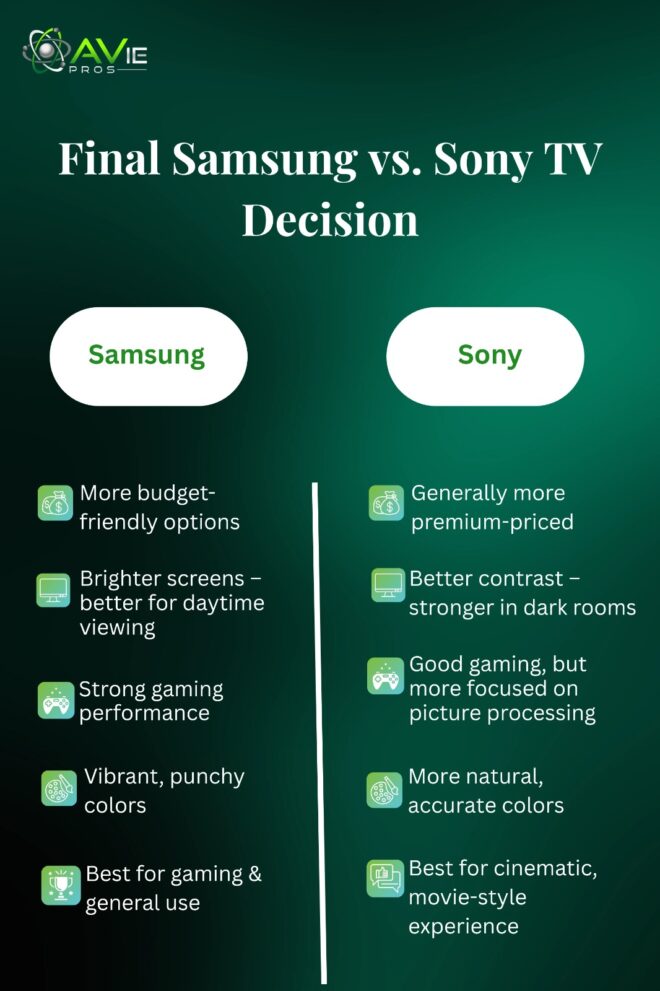
Samsung might be a better option if you’re searching for a bright-screen, reasonably priced TV that you can use for gaming and watching during the day. Sony might be a better option if you’re searching for a TV with sound and visual quality that matches that of a movie. Globally, both brands are respected and trusted.
Conclusion
When it comes to comparing something and Sony TV, both companies have an extraordinary reputation, and the market adds powerful reviews. Samsung TVS are renowned for their creativity and clear features; on the other hand, the realistic sound and visual quality of Sony TVs are ideal. Both Samsung & Sony TVs provide excellent performance.
It’s totally up to you to decide which one suits you. It depends on your room lights, your cost capacity, and gaming needs. The decision is all yours. If you are fully aware of the difference between the two brands, then you are capable enough to purchase what you are looking for.
FAQs
1. What’s the main difference between Sony TV and Samsung?
One of the big and noticeable differences is that the Samsung brand focuses on brightness and vibrant color theory while Sony focus or natural colours and always works on cinematic contrast.
2. Which TV is better for gaming, Samsung or Sony?
Both are ideal choices for sure, but Samsung often offers you slightly lower input, while Sony works very well even with PlayStation consoles.
3. Are Sony TVs more expensive than Samsung?
Yes, in most cases, Samsung offers premium OLED models that are actually expensive.
4. Which brand lasts longer, Samsung or Sony?
Both brands are durable and reliable, but it’s totally up to you how you use them. The lifespan depends more on the usage and care.
5. Is something or Sony better for watching movies?
Yes, Sony is preferred for movies because its national picture processing and best contrast can give you a smooth experience and luxury feel specially if you watch it with OLED models.