Multifamily residences are used by several people, they provide special security challenges. This usually calls for the installation of different security systems, including security cameras, live surveillance cameras, CCTV cameras, and surveillance cameras. The different security systems are made for different reasons and have unique benefits.
This article would like to inform the reader about the many kinds of security systems and provide a comparison of them in relation to multifamily homes, especially focusing on live surveillance vs basic security cameras and how pricing and usage differ. Here are the topics to be discussed:
Difference Between CCTV and Surveillance Cameras
Multifamily security is a challenging issue that requires careful planning and the use of suitable technologies to guarantee everyone’s safety. The most common method for monitoring activity in residential building areas with high traffic has been closed-circuit television, or CCTV.
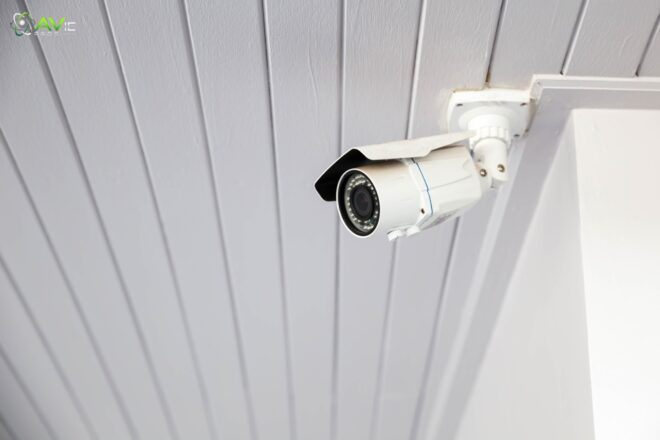
CCTV uses cameras that are linked to a network or central recording device to provide a live feed that is only available to specific people. As the name suggests, surveillance cameras have the same appearance and feel as CCTV models, but their main focus is on ongoing monitoring, using advanced analytics to quickly identify unusual activity.
Understanding the difference between CCTV and surveillance camera systems is important because choosing the right technology directly affects how well incidents are prevented and how large areas are covered using alarms, access control, and monitoring tools. It is directly tied to the possibility of security systems preventing incidents and covering wide regions.
What Are Surveillance Cameras
Surveillance cameras are designed to monitor activity in specific locations for a longer period of time, so they may be in operation at all times, seven days a week. Unlike basic recording devices, cameras are able to view locations in real time and can be connected with advanced security systems to identify and track unusual activity.
They are frequently found in public spaces, commercial buildings, and large multifamily properties where a continuous presence may be necessary to help prevent theft, damage, or unwanted access. This could include surveillance camera features like motion tracking, facial recognition, and remote access.
Which allow property managers to examine video, monitor resident safety, and quickly address any worries about possible problems. These cameras increase operational awareness in multifamily buildings without compromising the requirement for a noticeable security presence that prevents criminal activity.
Is a Surveillance Camera the Same as CCTV
A common question is “is surveillance camera the same as CCTV”, and the answer is no. While the terms “CCTV” and “surveillance cameras” are sometimes used together, they have different meanings. CCTV is a closed-loop system that primarily records and stores video by feeding it to a specific number of monitors or recording devices without any external access.
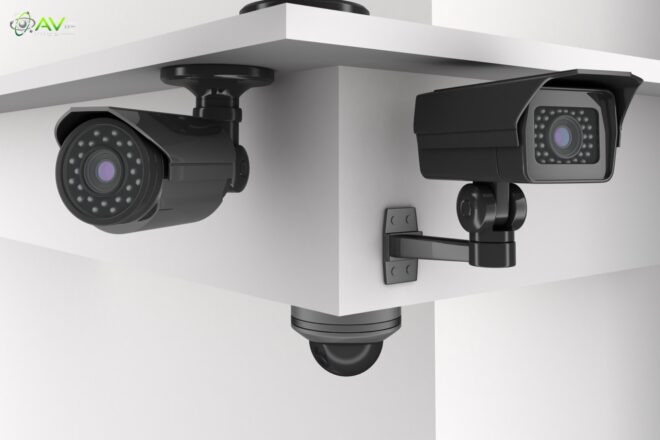
Although they can use CCTV principles, surveillance cameras are frequently improved with network connectivity, cloud storage, and advanced monitoring software that allows for remote viewing, motion alerts, and analytical insights.
Modern surveillance systems allow property managers to actively track activity and detect security threats. While maintaining oversight of multiple common areas without requiring their physical presence. Relying solely on CCTV in multifamily properties may limit responsiveness because it highlights post-event review.
What are Basic Security Cameras
These recording devices, often known as CCTV (Closed-Circuit Television) cameras, are made to keep an eye on actions that are triggered by things like motion and sound. They are wireless, very simple to install, and accessible from a distance via smartphone apps. In multi-family homes, this kind of technology can be used to keep an eye on activities in less dangerous settings.
These devices can do almost any surveillance function, including cloud storage, two-way audio communication, night vision, and push notifications for alerts when motion activity is detected. They are an affordable monitoring tool that can be used to keep an eye on office spaces, leasing offices, storage rooms, and other areas of an apartment complex where recordable activities are important to improving residential safety, but continuous monitoring may not be a top concern.
What is Live Surveillance
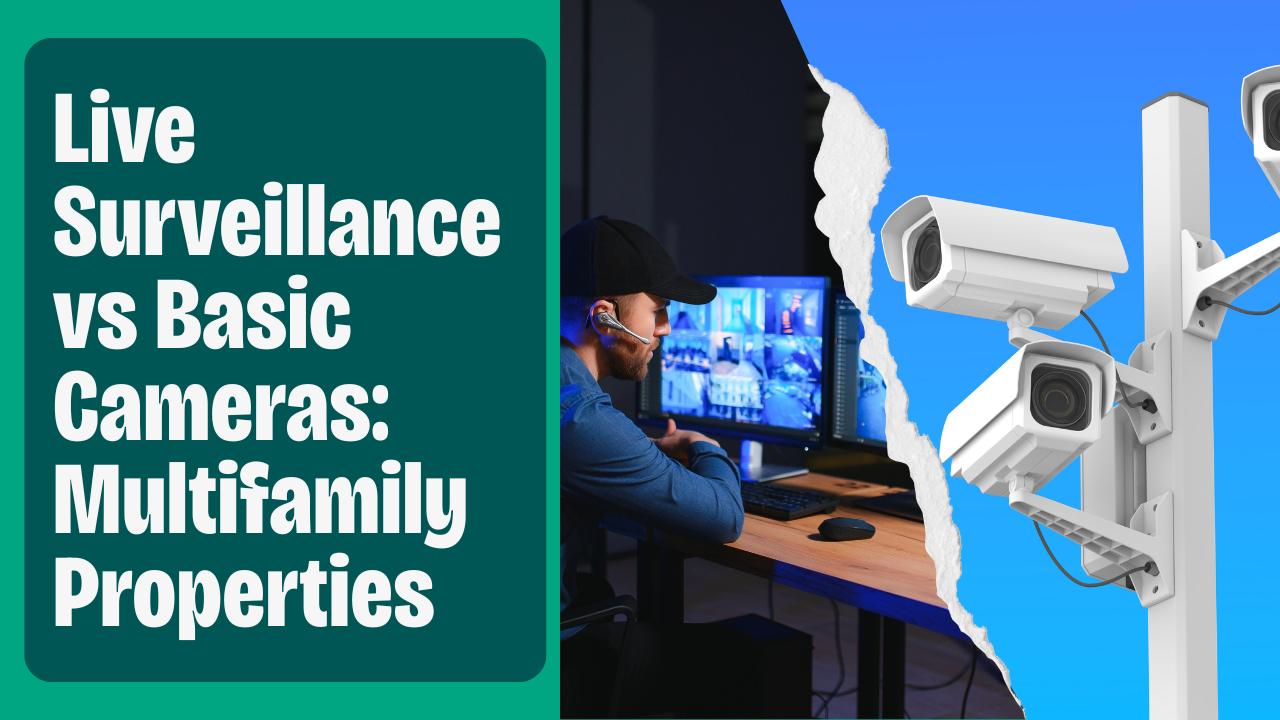
Live monitoring, which combines real-time human observation with cameras, is said to be the most advanced type of proactive monitoring. Unlike automated systems, live monitoring enables qualified staff to keep an eye on video feeds around-the-clock and respond quickly to suspicious aspects before a crime is committed or criminal activity takes place.
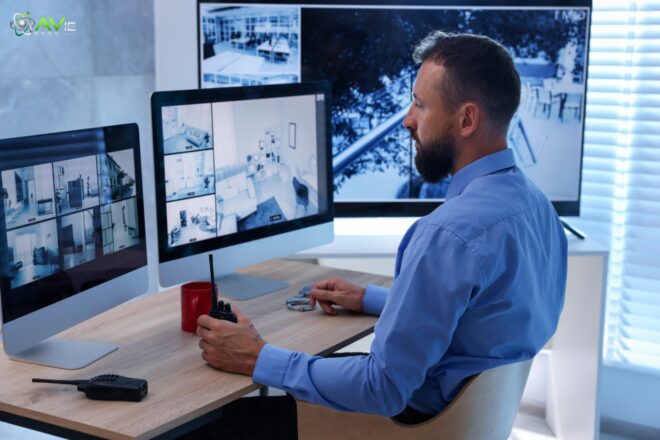
When necessary, live monitoring may involve direct notifications to security staff, voice communication with intruders, and immediate notification of nearby law enforcement agencies. Apart from enhanced physical security, the mere knowledge that live monitoring is available boosts residents’ confidence in the continuous management of their safety, which lowers the risk for property managers in terms of possible legal consequences.
Live Surveillance vs Basic Security Cameras
The amount of human contact and response is the main difference between basic security cameras and live surveillance. While simple security cameras rely on notifications, surveillance footage is reviewed after the incident has occurred.
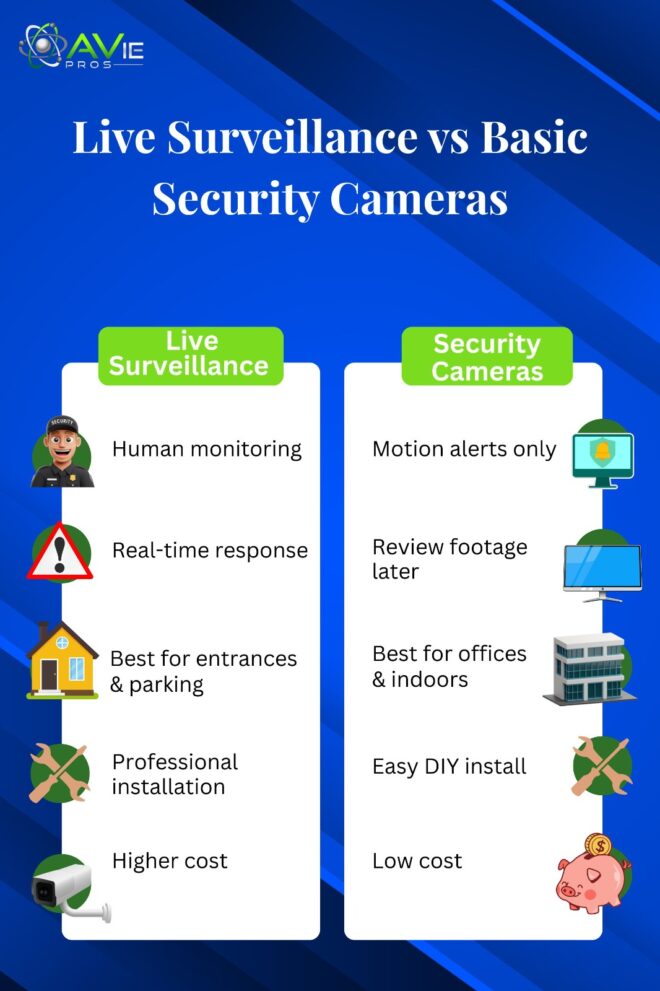
Live surveillance allows specialists to actively watch live feeds. It detects potential threats on an ongoing basis and takes proactive measures. Simple security cameras are better suited for relatively low-risk interior areas, administrative offices, or temporary surveillance.
Live surveillance can be successfully applied in high-traffic zones, entrances, parking lots, and external regions for multi-family homes. Understanding this, property managers can make good use of both systems in tandem, guaranteeing suitable safety allocations within specified financial limitations.
Let’s take a couple of steps to identify the differences between surveillance and security cameras:
1. Monitoring and Response Differences
One feature that differentiates live surveillance from standard CCTV systems is surveillance monitoring. For example, in live monitoring, CCTV footage is carefully reviewed by human operators who make decisions based on both deployed security measures and behavior seen in the footage. As a result, most CCTV systems do not require human making choices.
An automated detection system notifies the user if motion is detected or if the specified requirement has been fulfilled. This can be a very useful tool for documentation, but it doesn’t make decisions about how to handle situations in real time. If there is a lot of traffic or common assets that need to be protected, monitoring capabilities can be a very useful part of a building’s system in a multifamily community.
2. Installation and Setup Comparison
Compared to other kinds of basic home security cameras, the installation of monitoring and observation systems is more difficult. For such installations, experts are required. Simple home security cameras are easy to install wirelessly in multi-family homes. These home security cameras’ ease of use can sometimes happen in unmonitored areas.
The extremely valuable features of expert home security camera installations must be balanced against convenience. This important feature should be taken into account by the manager of the multiple-family property. The management of a multiple-family home should take into account a number of relevant issues.
3. Storage and Data Handling
In order to provide local video storage and secure monitoring, surveillance, and live viewing systems regularly use video storage on high-capacity devices like DVRs and/or NVRs. In order to assist property management in reviewing previous incidents, performing investigations.
And using the evidence for legal purposes, surveillance systems may preserve films for weeks or even months. Condo security cameras frequently use cloud storage, which allows for remote viewing but requires internet connectivity, which can occasionally result in fees.
While cloud storage solutions are easier to use and offer remote viewing capabilities, local storage solutions are more dependable and guarantee data confidentiality. The size of the property, security requirements, and additional viewing and storage demands all influence the choice of surveillance storage options.
4. Connectivity and Reliability
With camera systems, connectivity is important, particularly in larger multifamily buildings. Wired or hybrid networks are commonly used in surveillance and live monitoring to guarantee video quality and system stability. Modern security cameras depend on Wi-Fi.
Which might be impacted by interference, network congestion, or connectivity problems, resulting in delayed notifications or delays in video access. Sound connectivity is necessary for continuous recording, real-time monitoring, and quick event response.
For buildings with higher resident quantity, wired or hybrid systems are therefore recommended in order to maintain smooth operation. In order to guarantee that security systems operate as designed without coverage lapses or delays in reacting to events, proper network planning, redundancy, and bandwidth management are important.
5. Price Comparison Between Systems
When discussing live surveillance vs basic cameras price. Cost is the most important factor in choosing between basic security cameras and live surveillance. Because live surveillance systems require skilled installation, costly technology, and continuous monitoring services, they are typically far more expensive up front.
On the other hand, they offer better real-time prevention and response. In comparison to their fully monitored cousins, traditional surveillance-only systems likewise have high initial costs but very modest recurring expenses. Although they may have regular cloud storage fees, basic security cameras are the most affordable option.
They are very easy to install and have very few upfront expenses. In a multifamily situation, property managers must strike a balance between their budgets and security requirements, investing in live cameras when the risk may be high and enhancing them with less expensive cameras that may be used indoors in lower-risk situations.
Basic Factors We Can’t Ignore
Let’s consider some knowledgeable factors that are very essential to understand:
1. Choosing the Right System
A multi-unit home’s size, residents, community features, possible dangers, and price range must all be taken seriously when selecting an efficient camera system. Real-time video monitoring and strategically placed CCTV security cameras.
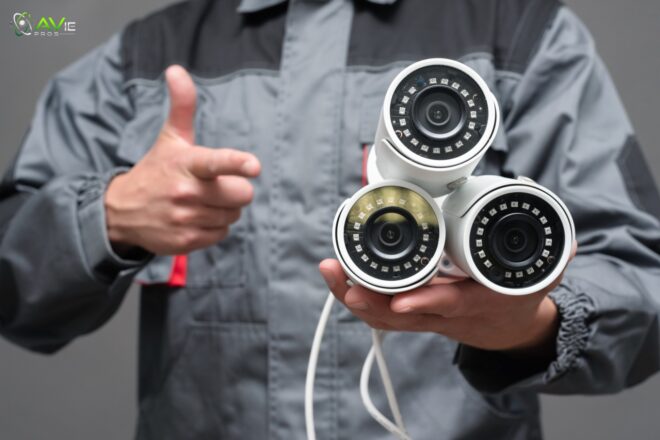
It should be installed in larger communities and areas where large numbers of people pass through on a daily basis. In order to respond quickly to threats. To improve security, safety, and affordability, smaller areas in a workplace or low-risk areas should use basic security cameras.
2. Maintenance and Long-Term Management
When it comes to the installation of camera systems, long-term maintenance is sometimes forgotten. To maintain the best possible performance, surveillance cameras, live monitoring systems, and CCTV systems must be routinely inspected, updated, cleaned, and maintained.
Batteries for basic security cameras must be changed, updated regularly, or updated on occasion. A maintenance schedule can be very helpful for multifamily organizations in order to maintain security cameras’ functionality.
Guarantee that recordings are saved, and ensure that their residents are always protected. Maintaining security systems properly can reduce incidents and increase their return on investment.
3. Application in Multifamily Properties
When installing security cameras in multi-family buildings, joint common areas, entry and exit points, and resident safety must all be taken seriously. Points of entry and exit, hallways, stairwells, parking lots, and elevators.
These are the primary locations for security camera and CCTV installations since continuous monitoring improves safety precautions and offers concrete proof of events. Real-time surveillance is an additional safety element.
This allows for quick action in the event of trespassing, break-ins, and other questionable activity. Installing basic security cameras is suitable for non-sensitive interior spaces and administrative offices. Therefore, in order to achieve a successful safety and risk management goal, developers of multi-family properties need to effectively use such camera systems.
Can Outdoor Cameras Be Used Indoors?
A common question is can I use outdoor camera inside, and the answer is yes. Outdoor cameras are capable of handling light, extreme temperatures, and environmental conditions. When necessary, they can also be used successfully in indoor environments. However, compared to inside cameras, outdoor cameras may seem larger and have more advanced features, such as infrared night vision.
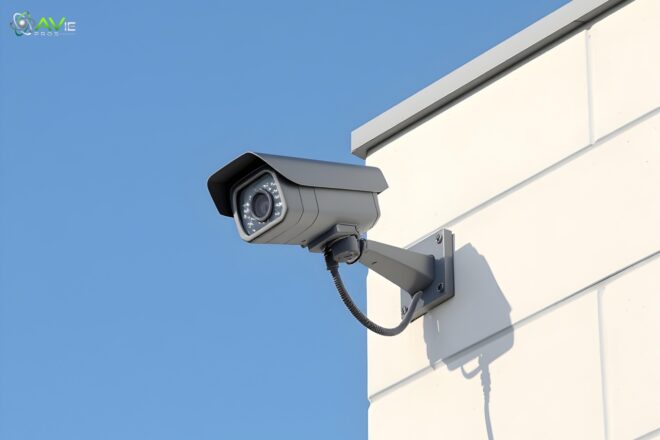
Managers in multifamily buildings should consider the application context when choosing cameras, to use cameras for outdoor use indoors when additional features or resistance to external conditions are required. When placed, cameras for indoor areas should also be protected from the sun and other environmental factors.
What are the Privacy and Legal Considerations?
When installing security cameras in apartments, privacy policies and requirements must be taken into account. Private spaces, such as toilets and private apartments, should never have cameras installed. Residents must also be made aware of and informed about security monitoring in shared spaces.
To avoid disagreements and legal issues, all state and federal regulations must be followed. Installing live security monitoring systems requires appropriate access control and limitations that limit the number of authorized people who can observe the systems. Property managers continue to be concerned about safeguarding security and preserving resident privacy in more crowded areas.
How Integration with Other Systems Works?
Alarm systems, access control systems, intelligent locks, emergency response systems, and other security components can be combined with modern surveillance cameras and monitoring systems. These components enable multifamily properties to have a single management system.
Which facilitates efficient and convenient communication between entry points, alarm systems, and security cameras. Although they lack advanced features like monitored systems, basic security cameras can be connected to a building management application or integrated with smart home appliances.
Integration helps to handle security as a single system by improving overall efficiency and responding quickly to situations. To provide both preventive and reactive security solutions, property managers may include motion sensors, alarm systems, door locks, and surveillance cameras.
The Future of Camera Technology
With the addition of artificial intelligence, facial recognition, behavioural analytics, and cloud-based management platforms, camera technology is fast developing. These features increase accuracy, lower the frequency of false alarms, and provide property managers with useful information.
Systems can automatically identify repeat offenders, spot unusual patterns, and keep an eye on high-risk regions thanks to advanced analytics. Today’s multifamily complexes are increasingly using hybrid systems. Which combine automated warnings, smart camera technologies, and live surveillance to offer complete security coverage.
The future of residential building security will undoubtedly be determined by an even greater convergence between intelligent camera systems and live monitoring as both technologies improve, making even more advanced features available to homes of all sizes and budgets.
Final Thoughts
Understanding the difference between live surveillance and security cameras makes us capable to understand the value of property assets and residence protection. Every system has advantages, with the help of a security approach, we can cover high-risk and low-risk areas. With the help of CCTV, we can keep an eye on live monitoring access control systems and other privacy and legal complaints.
The better system allows us to feel safe. The focus must be on careful planning, professional installation, and ongoing maintenance. Multifamily properties can definitely provide us with a safe, secure, and well-managed environment. Everyone can gain confidence and peace of mind living within the community.
FAQs
1. Can the camera connect with other systems?
Yes, with the new technology is modern cameras allowed their system to connect with alarms and locks. It improves the accessibility, efficiency, and overall security.
2. What’s the difference between cameras and basic cameras?
Surveillance cameras offer continuous monitoring, real-time alerts, and detailed analytics. On the other hand, basic cameras are only suitable for low-risk indoor places. Overall, surveillance is a better choice for high-traffic areas.
3. Can CCTV and surveillance cameras be used together?
Absolutely, CCTV records endlessly, and the surveillance cameras can add remote access control. By combining both of the systems, we can control full areas and entrance ways.
4. Are these live surveillance systems worth the cost?
Everyone knows that these are more expensive but definitely offer an immediate response to incidents. It make the life easier to deal with complex multifamily properties and high traffic issues.
5. Can outdoor cameras be used indoors?
Of course, it’s possible because they are durable. Indoor cameras are smaller and better for interior lighting and aesthetic looks.