The most common question that comes up when someone launches a new online business is which platform is best for their online store. Due to their popularity and availability of helpful tools, Shopify and Wix are sometimes mistaken.
However, they have been created for various user types and objectives. This article will explain the differences between Shopify and Wix so you can decide which is ideal for your company. Now let’s get started:
Introduction to Shopify and Wix
Shopify is a platform that is designed mainly for online retailers and is compatible with a wide range of business sizes. Shopify focuses on assisting you in creating a fully functional online store with strong abilities to handle sizable product lists and heavy traffic. Additionally, it provides you with a reliable system that maintains your store’s operation even when a large number of people visit it at once.
Your store can develop without any issues because Shopify is designed to enable long-term growth. Additionally, it provides a variety of apps that strengthen your store and increase sales. As a result, Shopify is trusted globally by both large and small companies.

Wix is unique in that it started as a website builder for basic webpages before adding features for online stores. For beginners who wish to have a website and a small store in one location, this simplifies Wix. It is simple to determine which one is a better fit for your company’s needs if you are aware of their purpose.
Wix allows you total control over your design, enabling you to rearrange items and make your own arrangement. It is ideal for people who want a fashionable website without having to learn complicated tools. Additionally, Wix offers a variety of templates that enable you to quickly begin building your website.
You have to decide which platform best serves your long-term objectives because they each address various issues.
Shopify vs Wix
Difference Between Wix & Shopify
Every website has some unique benefits and potential in the market. When the competition increases, people get confused to decide which one they should use. Likewise, a lot of users must be wondering to know whether Shopify is a hit for their business or Wix. Let’s understand both by the differentiation of their features and tools:
1. Features and Tools for Online Selling
With unique capabilities that boost sales, Shopify lets you manage an entire store, including inventory control, order monitoring, and customer profiles. Both small and large stores with hundreds of products can benefit from these solutions. Although Wix has online selling capabilities as well, the technique is not as effective for selling to large retailers.
Small companies that want simple and easy-to-sell solutions can benefit from its offerings. Shopify gives you greater power and control if you desire advanced selling capabilities because the platform is designed specifically for online sales. Wix offers an easy setup that works well for new sellers if your company wants basic selling choices.
2. Scalability for Future Growth
You’ll need a platform that can manage more products, clients, and orders if your store begins to expand. Shopify’s ability to enable business growth at every level makes it ideal for this. Without switching platforms, you can start small and expand into a major store. Wix, on the other hand, works well for small and medium-sized businesses.
But it isn’t the greatest option when your store grows to be very large, has a lot of traffic, or has an important inventory. Shopify is a better choice if you’re looking for a platform that can quickly grow with your company. Wix works well at first, but as your company expands and requires advanced capabilities, it could become annoying.
3. SEO and Online Visibility
Wix and Shopify are known for providing excellent SEO solutions that improve your website’s visibility in search results. For an e-commerce website to score highly in search results, Shopify provides a clear structure, quick loading speeds, and powerful SEO options. Even for beginners, Wix’s setup is remarkably easy, with its many improvements over the years.

Shopify offers faster and cleaner coding if your goal is just to rank an online store. However, Wix performs well if your goal is to rank a website with mixed pages, such as blogs, portfolios, and small store goods. It all depends on your goals for SEO and the type of website you are developing.
4. App Store and Add-ons
One of the biggest app stores in the e-commerce industry is provided by Shopify. Apps for marketing, shipping analytics, design automation, and many additional powerful features are included. These apps provide advanced options for business expansion and assist you in making your store better. Although there are fewer apps available, Wix has its own app market.
Although it doesn’t have as many advanced features as Shopify, it still has useful apps. Shopify is a better option if you want a store with add-ons that let you expand on your own. Wix is sufficient if you’re looking for simple apps for easy jobs. The number of apps you require depends on the size of your company.
5. Customer Support System
With tools like email support, live chat, and useful instructions, Shopify offers excellent customer service. Many problems can be quickly resolved by the support staff, who are only trained to handle issues with online stores. Wix offers chat and guide support for customers as well, but it is designed for a variety of websites other than retail stores.
Shopify support has a thorough understanding of e-commerce, which enables companies to resolve selling-related problems more quickly. Beginners can benefit from Wix’s assistance since it handles common website-building issues. Shopify is a better option if you need specialized support. For small companies, Wix assistance is enough for basic website needs.
6. Themes and Templates
Shopify offers a variety of templates designed especially for online retailers. The main focus of these themes is on easy shopping, quick speed, and a clean layout. The majority of them are paid, yet they provide expert design suitable for any kind of business. Wix offers hundreds of templates covering a wide range of industries and website types.

They are highly adaptable and simple to edit. Shopify themes are doing much better when it comes to pure e-commerce. Wix templates provide a lot more creative design flexibility. Whether you want a store-focused website or a design-focused website will determine which option is best.
7. Blogging Options
Wix and Shopify both allow blogging, but their goals are different. Because Wix was designed for standard websites, writing there feels more adaptable and simple. It is beneficial for small businesses and content producers who wish to publish on a regular basis. Blogging on Shopify is good, however, it’s not really flexible.
It is mainly designed to assist online retailers that wish to offer product information, advice, and guidance. Wix is more comfortable if your company depends significantly on blogging and content. Shopify works well if selling is your primary objective and blogging is just a supporting tool.
8. Marketing Tools
Shopify offers excellent marketing options for social media promotions, email campaigns, and advertisements. You may effortlessly automate several operations thanks to the products’ perfect connectivity with the app store. Wix also offers marketing capabilities, however, they are mostly designed for small websites and are not highly advanced.
As your store expands, Shopify technologies help you increase both your customer base and sales. For beginners who want simple marketing, Wix tools might be sufficient. Shopify provides stronger facilities and deeper support if your company needs advanced marketing techniques.
9. Inventory Management
Managing inventory is important for any company that sells a lot of goods. You can control stock levels, track products in real time, and prevent overselling with Shopify’s advanced inventory features. And even if you sell hundreds of items, these definitely will help you keep your store organised.

Small online stores can benefit from Wix’s inventory features, which are quite basic. Wix is useful if you sell a small number of products. However, Shopify offers you greater stability and control over a vast catalog. Here, the only things that matter are the quantity of goods you wish to sell and the rate at which your company will expand.
10. Shipping and Delivery Options
Shopify offers powerful shipping features, including third-party shipping apps, custom delivery regulations, and international shipping costs. It assists you in accurately setting up delivery prices for different regions. Although Wix has shipping services, small businesses with simple shipping requirements benefit most from them.
Shopify is preferable for stores that sell to multiple locations since it provides more advanced delivery settings. Wix shipping is easy and ideal for small-scale or regional sellers. Shopify would be the best option if your company requires advanced shipping management. Wix can easily handle limited shipping requirements.
11. Multichannel Selling
Shopify enables multichannel selling, which means you can use a point-of-sale system in person and on other platforms like social media and online marketplaces. This expands your company’s reach and promotes its growth. Multichannel is also possible with Wix, however, Shopify’s platform is more powerful.
Shopify makes it simple to link all of your channels in one location, which helps you manage a successful store. Wix is useful for small businesses that can feel limited by more demanding sales requirements. Shopify is the best option if you want an audience that is larger audience. Wix is the best option if you want simple selling.
12. Pricing Plans
While Shopify’s pricing is slightly more costly, its plans come with powerful tools that promote real business growth. You get strong features that boost sales and make it easier for clients to shop with you. Wix is more affordable and suitable for beginners on a tight budget. The rate is appropriate for small business websites and basic shops that don’t require selling tools.
Shopify’s price is more cost-effective if you are planning a huge store. Wix is more affordable if your company is small and you have a tight budget. Your level of belief in long-term internet sales will decide what the best approach is.
13. Payment Options
Many payment options, including well-known ones that customers use worldwide, are supported by Shopify. Additionally, it has Shopify Payments, which improves payment processing. This keeps your store operating smoothly and enables customers to make payments more quickly. Additionally, Wix works well for small businesses looking for simple payment facilities and accepts a wide variety of payment methods.
While Wix keeps things simple, Shopify charges additional costs for using third-party gateways. Shopify is superior if you desire international payment flexibility. Wix is sufficient if you’re looking for a simple system with fewer options. The number of payment options you wish to provide your clients will guide your decision.
Other Factors Comparison (Wix vs Shopping)
People are also concerned to know how both websites help in user experience, mobile performance, and more. Let’s crack down for a better understanding:
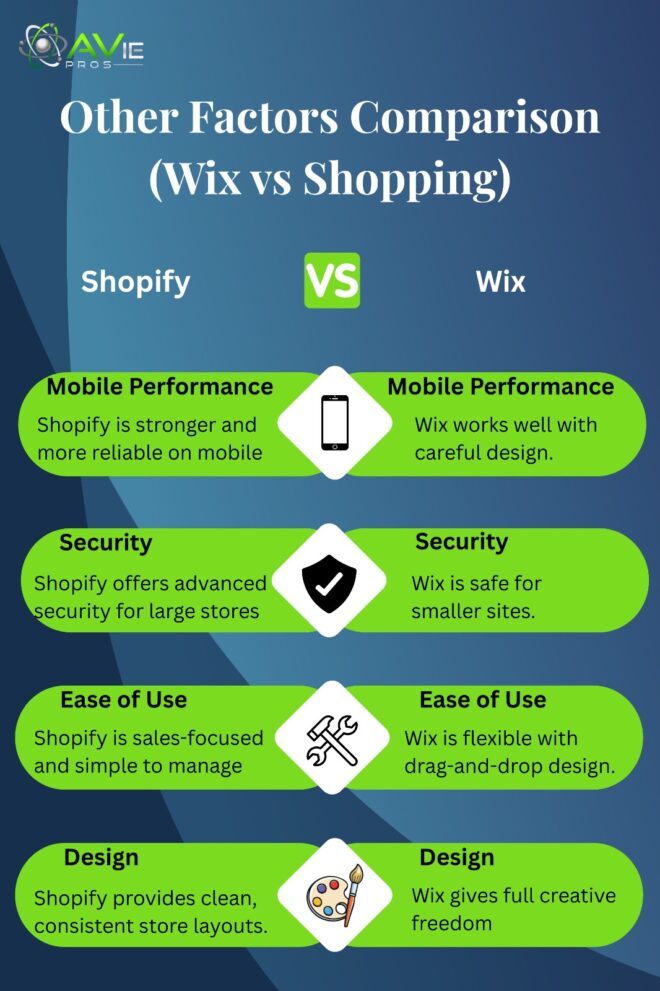
1. Mobile Performance
Since the majority of customers shop from mobile devices, a decent online store must function properly on phones. Themes have been designed for smooth browsing, and Shopify’s mobile performance is strong. This makes shopping quick and simple for your customers. Wix’s mobile performance is also good, although if the design freedom isn’t used correctly.
It will sometimes damage the mobile layout. While Wix offers more flexibility but necessitates careful modifications, Shopify maintains accuracy in mobile design. Shopify is a safer choice if your company plans to receive a large number of mobile visits. Once you have taken the time to correctly adjust your mobile layout, Wix functions properly.
2. Security and Safety
Security is very important for online stores because customers share sensitive details during checkout. Shopify offers strong security with built-in protection and automatic updates. It includes SSL certificates and follows industry standards that keep your store safe. Wix also offers SSL security and protects your website from basic threats.
Shopify is better for large stores that require strong security layers. Wix gives safe options for small websites. If your business is dealing with a lot of payments and customer details, Shopify gives more reliable protection. If you run a small shop, Wix security is enough.
3. Ease of Use
Wix and Shopify are both well-known for their simple setup, but their user experience is different. Everything you see is centered around your business because Shopify is simple but heavily focused on online sales. You may add products, manage orders, and check your sales with the help of this tidy dashboard. Because Wix uses drag-and-drop design, it gives users more flexibility and is therefore highly user-friendly.
Especially for people who require a nicely built website quickly. Wix will feel smooth if you are the type of person who loves designing and wants complete control. Shopify offers a better structure if selling things is your main goal. Your comfort level and the type of business you wish to run will decide everything.
4. Store Design Experience
Wix is famous for its design flexibility, which lets users drag and drop items wherever on the page. This allows the user complete creative power, making it easy to create a unique-looking website. Because Shopify themes are more organized, even when you add a lot of products, the design remains organized and consistent.
Shopify is more concerned with providing your customers with a seamless, online shopping experience. While Shopify offers similar, polished store layouts, Wix offers design flexibility. Shopify is the best option if your company wants a powerful e-commerce layout. Wix is a better option if you desire complete visual independence. The ideal platform will depend on your design style.
5. Long Term Value
Selecting a platform is about more than just what works right now. it’s also about what will help your company in the future. Because Shopify is designed for growth, it provides long-term value. You can manage a growing store with the help of powerful tools, apps, and integrations.
For beginners and small businesses, Wix offers good value, but it may eventually seem limited. Shopify is the best option if you desire a long-term business. Wix is a good option if you want a simple and long-lasting website with few sales. Which platform offers the most value will depend on your goals for the long run.
Which Platform Is Better for Beginners
Wix’s easy-to-use design controls and simple interface make it seem more accessible for a basic website with a small store. Shopify is also rather simple, but it seems less attractively adaptable and more focused on business. Shopify is a great place to start for those who are just starting and want to build their store slowly.
Wix is a good choice for people who will only have a small store and a casual website. The size of one’s business goals and the rate at which they wish to expand their online store will determine which is preferable.
Shopify Pros and Cons
Pros: Shopify comes with many strong points that help online sellers run a stable and powerful store. It gives you fast performance, strong security, a big app store, and tools that support growth at any level. It feels professional and works smoothly even when your store becomes large.
Cons: The main drawback is that Shopify can feel a little strict for design, and it can also become expensive when you add many apps. Some beginners also find it slightly complex in the start because it focuses only on selling.
Still, it gives long-term value and supports business expansion, which makes it one of the best choices for serious sellers.
Wix Pros and Cons
Pros: Wix is very easy for beginners because of its drag-and-drop design system, which gives full visual control without effort. It lets you build a beautiful website quickly and add a small store whenever you want. It is also cheaper, which helps small businesses start without pressure.
Cons: The main drawback is that Wix is not as strong as Shopify for large stores because its tools are basic and less powerful. When your business grows, you may feel limited in features, apps, and advanced selling options.
Still, Wix is great for creative websites, simple stores, and small businesses that want comfort and easy control without learning complex systems.
Conclusion
Both Wix and Shopify are excellent solutions, however, they are designed for different kinds of business requirements. With powerful features, quick performance, cutting-edge applications, and long-term growth, Shopify can support major online retailers. For medium-sized and large companies that genuinely want to grow, it will be ideal. Beginners who require simplicity in design, a quick-to-build website.
A straightforward store will find Wix to be ideal. For small businesses that require affordability, ease of use, and beauty, this will be ideal. Making the best decision will depend on your company’s size, selling objectives, and future goals. Shopify is the best option if you desire effective selling. Choose Wix if you desire a simple design.
FAQs
Is Shopify better than Wix for online stores?
Shopify is better for serious online businesses because it offers strong tools and advanced features that support growth. Wix is better for small stores and beginners who want an easy setup.
Is Wix cheaper than Shopify?
Yes, Wix is usually cheaper and suits small businesses. Shopify costs more but gives stronger e-commerce tools that help in long-term growth.
Which is easier to use, Shopify or Wix?
Wix is easier for beginners because of its drag-and-drop system. Shopify is also simple but more structured and focused on selling.
Which platform is better for large stores?
Shopify is better for large stores because it can handle big product lists, high traffic, and advanced selling needs without slowing down.