Anyone who doesn’t know how to write an article step-by-step may find it difficult. Because they simply don’t know where to begin, the majority of people are confused. They attempt to write, but their ideas don’t flow together coherently. You will learn how to write an article step-by-step from these instructions.
Even a total beginner can understand everything because it is written in simple language. You will learn how to select a topic, do research, organize the work, and then write clearly. Let’s get into:
Understand What an Article Is
Selecting your topic is the first step in writing an article. Your topic needs to be easy to understand. Your article will be confusing if your topic is too vast. Always choose one concept that you can thoroughly describe. You can write more confidently because you are fully aware of the topic of the article. Additionally, it makes your goal clear to the reader.

The whole article is easier to write when the theme is clear. You’ll be aware of what to include and what to delete, as well as the direction your steps are taking. To stay on course, go back to the subject and remind yourself of the core concept if you feel like you’re getting stuck while writing. For this reason, one of the most important steps is selecting a suitable topic.
Steps Before Writing an Article
There are multiple steps that matter a lot. We know that before delving into any process, we need to be prepared first. Let’s understand what important steps are that we need to look at first:
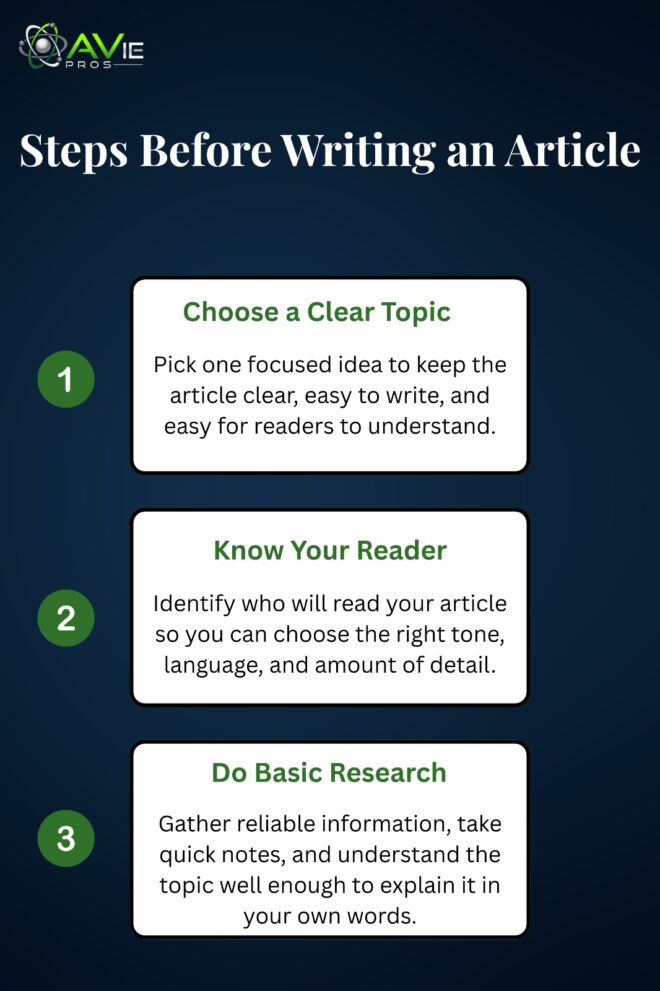
1. Choose the Topic
Choosing your topic is the starting point of your article. Your topic must be clear and simple. If your topic is too wide, your article will become confusing. Always pick one idea that you can explain in detail. This helps you write with confidence because you know exactly what the article is about. It also helps the reader understand your purpose without any confusion.
A clear topic makes the whole article easy to write. You will know the direction of your steps. You will know what to include and what to remove. If you feel stuck while writing, go back to the topic and remind yourself of the main idea. This will pull you back on track. This is why choosing the right topic is one of the most important steps.
2. Know Your Reader
You must decide who will read your article before you begin. Each reader is different. Some readers don’t require much explanation because they already know a lot. Some readers require the simplest language available because they are complete beginners. You can select the right tone once you are familiar with your audience. The simplicity of your sentences is up to you. Additionally, you can decide how much information to include.
Getting to know your reader improves communication. Because it is, it gives your article a pleasant and familiar feel. The reader will stay on your page longer if they feel understood. They read the content through to the end and find it useful. Because of this, understanding your audience is important because it impacts your writing style and the whole content of your article.
3. Do Research About the Topic
You can learn more about your subject by doing research. It provides you with information, concepts, and examples that improve your work. Simple articles don’t require thorough research. You can just read a few reliable books or websites. You can make brief notes about what you’ve learned. The goal is to understand and write in your own words, not to copy others.
Additionally, research boosts your self-confidence. Your writing improves as you gain more knowledge. You have a thorough understanding of the subject, which makes your conclusions seem clear. You can avoid mistakes by conducting research on your subject. You may verify that you are providing accurate information by checking your facts. Your content can benefit greatly from even basic research.
Step-by-Step Writing Process
This part explains how to write your article step by step. Each step is important. Each step has its own heading and explanation. Follow these steps in the same order. This makes your writing clean and easy to follow.
1. Create a Good Title
An excellent title tells the reader exactly what the article is about. It has to be simple and clear. Readers will skip the article if the title is unclear. Thus, use a title that simply describes your subject. A simple title works better than a lengthy one.

The goal of your work should be reflected in its title. If it is a guide, the headline needs to indicate that it provides knowledge. “How to Write an Article Step by Step,” for example, is understandable and helpful. At first sight, anyone could understand it.
Your headline may also contain a promise. A promise is a guarantee of an advantage. For example, the article “How to Write an Article Step by Step for Beginners” claims that it is simple for beginner writers. This attracts additional readers.
2. Write the Introduction
The topic of the article is explained to the reader in the introduction. It must also explain the importance of that subject. Before proceeding, readers want to know what they will learn. They stay and read more when the introduction is clear.
You should give a brief introduction. Try to limit it to two or four brief sentences. Don’t include any more information here. Put such details in the main body. The reader should only be guided into the article by the introduction.
3. Break the Body Into Clear Steps
When you teach a process, you must use steps. Steps help the reader follow the order. They also make the writing clean and easy to understand. Use one idea per step so the reader does not get confused. This structure makes your article strong.
Step 1: Choose a Topic and Goal
Pick a small topic. Choose something you can explain easily. Decide the purpose of your article. Know whether you want to inform or teach.
Step 2: Research Fast
Read a few trusted sources. Note important points. Do not read too much. Take only what you need.
Step 3: Make an Outline
Plan your title, introduction, body, and conclusion. Write one line under each section. Keep it simple.
Step 4: Write the First Draft
Write fast and do not stop. Do not worry about mistakes. Keep sentences short. Follow your outline.
Step 5: Edit for Clarity
Fix confusing lines. Shorten long sentences. Remove extra words. Make every idea clear.
Step 6: Proofread for Errors
Read slowly. Check spelling, grammar, and repeated words. Read aloud to catch mistakes.
Step 7: Add Final Polish
Fix the title if needed. Check the introduction again. Make the ending strong. Make the article smooth.
4. Write the First Draft
Your article is based on the first version of your work. This phase does not require perfection. Simply write down your thoughts one after the other. Never stop correcting minor mistakes. In this manner, you can continue writing without interrupting your flow.
Make use of this outline as a reference and keep to it properly. Confusion is avoided as a result. Short sentences make writing easier, so you must use them in this first copy. Later on, you can make adjustments. You only need the primary ideas on the site for the time being.
5. Use Simple Words
Everyone will find your content easy to read if you use simple language. Reading is slowed down by difficult words. If the terms appear challenging, readers with little education can stop reading. Therefore, you must always select the most basic word. The most important guideline for writing clearly is this one.
Give a one-sentence explanation of any difficult terms you must use. For example, “SEO means getting traffic from search engines.” That makes it easier for readers to understand without feeling confused. The flow is maintained with a brief explanation.
6. Keep Sentences Short
Your reader will read more quickly if you use short sentences. They also avoid misunderstandings. Long sentences are more difficult to understand. They also require a lot of commas. Reading is slowed down by commas. For this reason, most people respond well to brief sentences.

Ten to eighteen words should be used in each statement. The writing becomes clean as a result. Divide a sentence into two shorter ones if it is becoming too long. This will make your post easy to read and understand for anyone.
7. Make Paragraphs Short
Short paragraphs help your article look neat. They simplify reading. Because they appear huge, lengthy paragraphs can be nervous readers. To make the article lighthearted and approachable, always utilize brief paragraphs. One notion should be the main focus of each paragraph. Avoid combining a lot of things in one area.
The message becomes clear when you use just one idea per paragraph. The flow is enhanced by this style. Two to four sentences make up the majority of well-written paragraphs. On desktops and phones, this size is easy to read. Additionally, short paragraphs make it easier for the reader to go from one idea to another without getting bored.
8. Use Examples
Examples offer clarity to your writing. They clarify the thoughts among readers very quickly. Furthermore, a straightforward example can convey ideas that many phrases are unable to. For this reason, examples play an important role in tutorials and manuals.
Additionally, examples give your article a genuine sense. They explain to readers how to carry out their steps. They clear up any confusion and encourage action from the reader. Readers learn more quickly when they are presented with a clear example.
9. Add Transitions
Transitions improve the flow of your ideas. They suggest to the reader that you are entering a new section. The content seems confused if there are no transitions. The readers become bored with what you’re trying to say.
Transitions are therefore essential. Transitions might be as basic as “Next,” “After that,” or “Now do this.” Long phrases are pointless instead, you should use brief transitions to maintain a simple flow.
10. Write a Clear Conclusion
A conclusion reminds the reader of what they learned. It also repeats the main benefit of your article. This helps the message stay in their mind. A strong conclusion leaves a good final impression.
Your conclusion should be short. Keep it simple. Tell the reader what they can do next. This gives them direction. A short and clear conclusion is better than a long and confusing one.
Final Steps Checking
Lastly, a final check clarifies the whole article’s mistakes. You can maintain a clear vibe and language throughout the article. Let’s have a quick look:
1. Edit Thoroughly
The process of editing is what makes your article stronger. Editing clarifies the concepts by removing errors and unnecessary words. Read one paragraph at a time while editing. Make basic queries about yourself. Is the concept clear? Are the sentences brief?
Can I use words that are simpler? You can improve your writing by answering these questions. Anything that doesn’t support the main idea should be cut. Remove weak words. Make use of simple and expressive language. Saying “start” rather than “get started,” for example, will improve the strength and speed of your writing.
2. Proofreading
Spelling, punctuation, and word repetition are among the small mistakes that proofreading looks for. You’ll miss stuff if you’re rushing, therefore you must be patient. Take your time. It will have an important effect. Because you will hear mistakes that you do not notice, reading aloud can also be beneficial.

You’ll notice odd lines and any gaps. Proofreading is made simpler and more efficient with only this small tip. If you’d like, use a simple spell checker. However, don’t rely on it. Many things are missed by computers. The best tools are still your eyes and ears. So pay close attention while you read.
3. Check Facts and Links
If you use numbers or facts in the article, double-check them. Verify that everything is accurate. Inaccurate information decreases readers’ trust and confuses them. Thus, always double-check your information. Check each link to see if you added any. Verify that the correct page opens. Broken connections appear irresponsible. They irritate readers as well. Although it just takes a few minutes, this process is quite beneficial.
Your article’s strength is its accurate facts. They treat your reader with respect. They also safeguard your writing reputation. Thus, always take the time to verify the facts. Skilled writers pay close attention to details. Before publication, they ensure that everything is accurate. You will develop as a writer if you adopt this habit.
4. Add a Good Title Again
You can change the title after editing. Frequently, the better one comes to mind. That is typical. You may create a stronger title with a new look. Your final title should be precise and simple.
Including your primary keyword in the title will make it easier for readers to find your post online. It is helpful to include just one basic term in the title. Don’t overdo SEO, make it natural.
5. Craft a Strong First Sentence
The opening sentence needs to grab the reader’s attention. When readers open the article, it is the first thing they see. They will stay if the opening statement is strong, but they are going if it is weak.
As a result, this section is important. Simple first sentence examples include: “Writing is a skill.” You can learn it. Alternatively, you may ask, “Do you want to write a clear article?” These are brief but powerful lines.
6. Use Headings and Subheadings
Headings are what make your essay easier for people to understand. They inform students about the start of each concept. They additionally decrease the weight of the product. The structure is kept short and simple with crystal-clear headings. The finest headlines are brief ones. Long headings appear confused. Make sure the headline reflects the idea under it. This makes it easier for readers to follow the story without becoming confused.
For larger articles, use subheadings. Subheadings divide the content into small sections. They help with reading the article. This makes it easier for readers to quickly find what they need. Your content is enhanced by well-written headings. They move the reader from one section to the next with simplicity. They play an important part in writing clearly.
7. Use Numbers for Steps
Numbers represent order. They assist readers in following each stage individually. Numbers help you understand what you’re teaching. They help the reader stay on target. The numbers appear orderly.
They show advancement. The reader is aware of their current position in the process. This keeps them focused. For this reason, numbered steps work best in guides.
Additional Tips
Tips and tricks make your writing better. Here are a few tips that will enhance your overall writing:
1. Add Examples From Your Life
Real examples make your article strong. They show that you have real experience. They help readers trust your steps. Real examples also make your message simple and human.
2. Avoid Jargon
Jargon means technical or complex words. These words confuse readers. They make the article heavy. That is why you must avoid jargon whenever you can. Jargon breaks the flow of writing. It makes the reader slow down. It reduces understanding. This can make readers leave your article.
3. Use Short Quotes if They Help
A short quote can support your idea. It can make your point stronger. But it must be simple. A quote that is too long becomes heavy. So always use short ones. Quotes from experts can add trust. They show that your idea has support. But keep the quote to one line. Simple and short lines are the best.
4. Check Length
Your article must not be too short or too long. For web content, many articles are between 800 and 2000 words. But guides can be longer. You are writing a detailed guide, so long writing is fine. Even if the article is long, keep it simple. Do not repeat ideas. Do not use fancy words. Stay focused on the topic. Clear writing makes long.
5. Add Images or Examples if Possible
Learning is made easier with images. They provide concepts in a very basic way. Some readers find that using pictures helps them understand. Therefore, adding an image can be exactly what your message needs to make sense.

It might be explained with a brief caption below the picture. Don’t complicate the caption. The meaning of the image must be explained to the reader in the caption. This makes everything clearer.
6. Optimize for Search Engines (Simple SEO)
Use basic SEO if you want your article to show up in search results. Making your post simple for search engines to understand is known as SEO. Advanced skills are not required. Easy steps will be enough.
Put your primary keyword in the title. In the introduction, use it once. In the article, it is mentioned several times. Don’t stuff your text with too many keywords, this will make it look poor.
Final Words
When you follow the correct procedures in the correct order, writing an article is not difficult. You learnt how to choose a topic, do research, create an outline, write a draft, modify it, and proofread it. Additionally, you learnt how to use short sentences and basic terms. These are small details that make a big effect.
They make it simple for everyone to read your article. You can now write about anything you want to. Follow this guide step-by-step. Be patient and keep things simple. The more you practice, the more confident you will feel. Writing is a gift that gets better every day. Enjoy the process as you begin writing your next article.
FAQs
What is the easiest way to start?
Start with a small topic. Make a one-page outline. Then write a short draft.
How long should an article be?
It depends. For the web, aim for 800 to 2000 words. For a guide, you can write more. Keep it useful.
How many sources do I need?
Two or three reliable sources are enough for a simple article.
How long does it take to write one article?
For a short article, one to three hours is common. For a long time, it may take more. It gets faster with practice.
Can I use AI to help?
Yes. Use it to get ideas. But always check facts. Make the voice your own.