

The success of any website depends on two major factors. Firstly, how users can easily use it, other one, how well it performs on search engines. These two elements are called UX and SEO. In this guide, we will understand how to balance UX and SEO for a successful online presence. What are the important factors, and how to optimize website for UX is also covered below. Let’s explore UX and SEO website optimization:
What Is UX and Why Does It Matter
UX stands for the User experience, which is helpful for your website. It includes everything from design, Layout, to speed. We can make the navigation accessible for visitors and provide a smooth overall experience. Poor UX can lead your users to move away from your website. Only clean UX encourages the visitors to stay longer and interact with your content.

Visitors can decide in a few seconds whether they need to stay on your website or leave it. Users are going to leave your website if the layout is very confusing and takes a long time to load. This will leave a bad impression on their minds and they will quickly leave. Keeping the content simple, easy, quick, and fun should be your goal. Start your website working with clear headlines, readable fonts, and very simple writing.
This means that each page should have a goal and guide users toward it. For example, if you have a product website, customers will be able to easily find the details cost and purchase descriptions. They will feel easy without simple scrolling.
What Is SEO and Why Is It Important
SEO or Search Engine Optimization is the process that improves your website ranking when people search for it. The main goal of SEO is to increase the visibility and bring organic traffic to your website. SEO involves a lot of elements such as keywords, content structure, hierarchy, backlinks, and the overall site performance.

When someone searches on Google for something, Google compiles similar data behind it and displays it on the page with rankings. It means that your website needs to be so optimized that it can rank at the top of the results. A well-optimized website is the key to your ranking. SEO is not the means of adding keywords only.
It is a process that includes technical aspects of your website. For example, page speed, mobile response, Meta tags, and content structure, all these things can affect your ranking. Google will only prefer your website if you post useful information with a good user experience.
8 UX Factors that Impact SEO
User experience is connected to SEO. Here are some UX factors that can impact your ranking. Let’s understand how to optimize for both UX and SEO and how these factors work and affect SEO:
1. The Connection Between UX and SEO
The two sides of a coin are UX and SEO. UX stands for the User experience, which focuses on how people feel when they visit your website. SEO stands for Search Engine Optimization, which helps your website to appear in high rankings as a search result. A lot of people think that you extent SEO is separate, but in reality, they are closely connected. When both work together, they create a website that is easy to use and attracts more visitors organically.
Together, they enhance how customers discover and engage with your website. Visitors remain on a website longer, browse more pages, and interact with your content when it has a good user experience. Your rankings will rise as a result of these acts’ good signals to search engines.
User experience is increasingly taken into account by search engines when analyzing rankings. Users’ interactions with a website are reflected in statistics like click-through rate, time, and bounce rate. Search engines believe your website is not offering value when visitors leave quickly or do not interact with it. Strong UX and SEO work together to please users and algorithms.
2. Page Speed and Its Role in UX and SEO
One of the most important factors for both UX and SEO is page speed. Particularly on mobile devices, people want websites to load quickly. Users get frustrated by a slow website and are more likely to leave before the page loads completely. It is currently a ranking factor for search engines.

Users will stay on your website longer and explore it fully if it loads quickly. They don’t leave, which lowers bounce rates and boosts engagement, all of which are beneficial to SEO. Page performance can be increased by optimizing graphics, using smart code, and reducing complex scripts.
Additionally, picking the right hosting company guarantees that your website will function smoothly even with heavy traffic. Fast websites are rewarded by search engines because they improve user experience. For example, Google’s Core Web Vitals track how fast your content loads and how stable the page is. Your website may become less visible in search results if it does poorly in these categories.
3. Mobile Experience and Optimization
Mobile optimization is one of the biggest priorities for UX and SEO. The ratio of mobile users is higher worldwide. People use their laptops and tablets less and use their phones for searching. If your site is not mobile-friendly, you will lose a huge audience. A mobile-optimized site automatically adjusts the screen size and allows users to use it easily through navigation.
Users should be able to read the text clearly, click the buttons, and scroll effortlessly. Google also uses a process of mobile-first indexing. Basically, it means how your website looks on the mobile version. Website developers need to be responsible for the design.
A responsive and clear design improves user satisfaction and search ranking. Mobile users access those websites that are easy to understand. The best tip is always to use simple and optimized pictures for small screens. So people can easily read the website text.
4. Visual Content for UX and SEO
Infographics, videos, and images enhance a website’s engagement and provide users with information in a matter of seconds. By dividing lengthy phrases into smaller sections, visual content improves user experience. Once you optimize your photos with meaningful file names and alt tags, search engines will also thank you for your work.
This means that your images can appear in Google Images and increase the visibility of your website. Visuals that complement your content encourage users to stay on your pages longer and share them, which benefits search engines. Instead of distracting viewers, always use high-quality images that load quickly and improve understanding. Let’s have a quick look at important strategies:
- A clean and well-designed website promotes ease. If your website looks busy or out-of-date, it will definitely affect your rating.
- Another important factor of visual design is readability. Make sure that the font size and the spacing are accurate so users can easily read and understand your content.
- Always promote clean and simple design. Don’t add over things to your website that will definitely affect the performance and speed. It will affect the SEO ranking too.
- High-quality images and infographics are very important. To make sure that your website’s visibility is correct, always use HD images. The infographic text should also be very clear and visual.
5. Voice Search and the Future of UX and SEO
With the help of Google Assistant, Alexa, and Siri, voice search is increasing in popularity. People are now speaking instead of typing their searches, and this has an important effect on how we create and optimize our websites. Natural and conversational content is what voice search means for UX.

This means using question-based phrases and long-tail keywords for SEO, such as “how to” or “what is.” Voice search performs better for websites that load quickly and provide simple, clear responses. This change in viewpoint pushes website owners to make their content more relatable, understandable, and in line with actual user intent.
6. The Role of Artificial Intelligence
We all know that artificial intelligence has totally transformed our lives. The role of artificial intelligence helps both user experience and SEO. People use AI tools to analyse the behaviour of users that come to their websites. These things help a lot to understand the audience. If we understand what kind of audience we have targeted, we can be capable to make our content better according to their choices. For example, you can ask for Google’s algorithm and target keywords to understand.
When it comes to UX side, AI definitely helps to personalize the content according to user preference. Without putting a lot of effort, we can make a website next level by using artificial intelligence.
AI can definitely suggest you articles, products, and videos to engage the visitors. You can also ask for AI to help you suggest keywords, track trends, and optimize meta descriptions. AI insights with human creativity can make your website faster, more effective, and smarter.
7. Content Connection
In reality, content is where UX website optimization and SEO truly meet. Content tells search engines what your website is about and how relevant it is. This is the information that users were searching for. The finest websites include readability, engagement, and clear, keyword-optimized content.
Users will become bored with your content if it sounds artificial or has an excessive number of keywords. The search engines can’t understand the purpose of your website if it is very unclear. It’s important to balance these two. Both readers and search engines benefit from writing in plain language, using unique headings, and correctly organizing content.
UX is also enhanced by the addition of internal links, graphic content, and clear calls to action. If users can simply navigate to relevant pages and find helpful information, they remain longer. All of these components immediately help search engines in analyzing and appreciating the structure of your website.
8. Navigation and Site Structure
A website structure is the key to controlling your audience. It’s a fact that if the website doesn’t look proper or perfect, people will never spend time on your website. A clear and smooth structure allows users to find the information quickly. Likewise, if you upload a lot of content on your website so far a users it’s difficult to find the particular one that he was looking for.
The solution is you add a search bar at the top of the header, so people can search and find content easily. If your website has a lot of Ads on the main page and the website looks so confusing, visitors will feel hesitant to invest time just to understand the layout.
Always work on the navigation and site structure. Keep all the things very simple. Always design your website in a way that visitors can easily get back to the homepage . For SEO, having a clear hierarchy of pages helps search engines crawl your site more effectively. Important pages should be easy to access from the main menu, and URLs should be simple and descriptive. The smoother your structure, the better your site performs overall.
How to Balance Design and Optimization
A beautiful design is fantastic, but an excessively decorated website degrades its SEO and functionality. Heavy graphics or flashy animation may cause websites to load more slowly, which could harm user experience and rankings. The goal is to achieve a balance between clear content, quick performance, and clean design.
Every design component should have a purpose, such as guiding users with simplicity and clarity. Make sure your pages are easy to access, use consistent colors, and maintain simplicity. Websites that are both attractive and useful are rewarded by search engines. Long-term success will be made easier by finding a balance between technical optimization and creativity.
What is the Role of UX in SEO?
Websites are ranked by search engines based on user activity. Your website is adding value when visitors stay on it longer, visit multiple pages, and interact with your material. SEO has been greatly affected by direct user interaction signals. Positive user behavior is supported by good UX.

For example, people are more likely to click on other sites or share your content if they read it and find it enjoyable. They will leave if they are confused or if your website loads slowly. A strong SEO and a positive user experience are shown by a decrease in click-through rates and an increase in session duration.
How to Create a UX and SEO Strategy
Creating a website that works effectively for both UX and SEO requires careful planning. Consider your audience before you start writing or designing. Understand the type of information they will be looking for, how they browse, and what they are looking for.
After performing keyword research to figure out what users are looking for, content that directly addresses those queries should be produced. Every page should have a purpose, whether it be to connect, inform, or sell. Make sure the design facilitates readability and navigation.
Technical optimization, which includes safe HTTPS, no broken links, and page loading speed, is equally important. Use tools like Google Search Console to monitor your website’s performance on a regular basis and address any problems that could affect SEO or user experience.
How is Accessibility Helpful for UX and SEO?
Accessibility is a true partner that can assist you in user experience and search engine optimization. For example: A website is designed with readable font, images with alt text, and keyboard navigation. That will look so impressive and accessible for the visitor. People will spend time reading the content. All you need is, make a truly user-friendly website that is accessible for everyone, including those who are not well-educated.
If the accessibility is better, your ranking will go higher and higher. Because the organic traffic makes a big difference in ranking. People will start trusting your website and will support you. That will create long-term success for you.
Why UX and SEO Success Measuring Matters?
If you don’t measure, you can’t get better. Google Analytics provide you with UX insights that help you to understand user behavior on your website. You can learn what’s working by looking at metrics like average session duration, bounce rate, and conversion rate. You may track click-through rates, keyword rankings, and organic traffic for SEO.
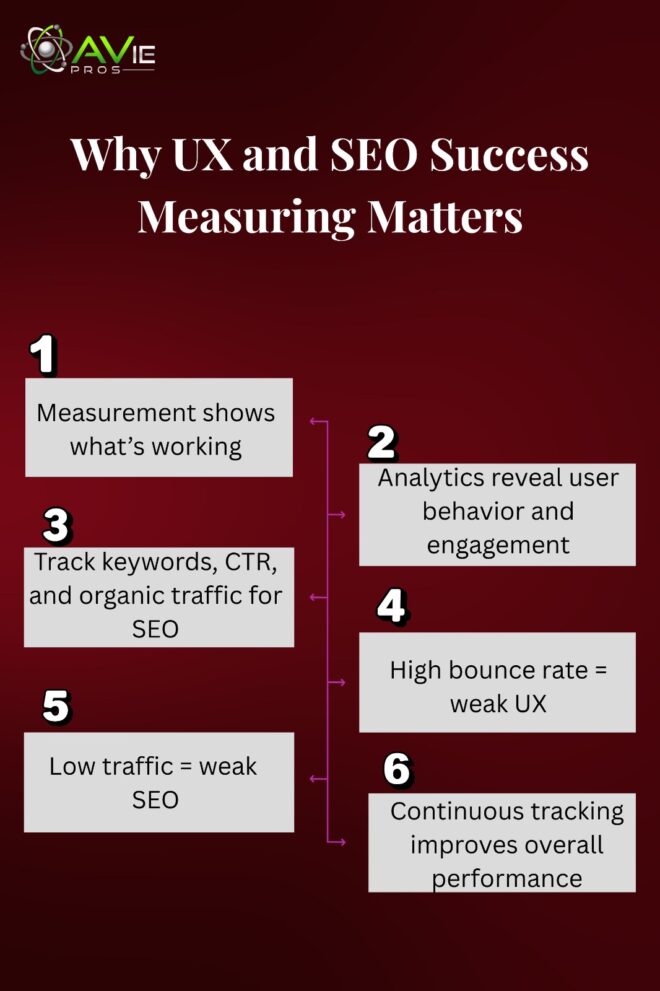
Your user experience (UX) may be poor if visitors frequently leave your website or fail to complete the targeted tasks. Your SEO strategy may need to be adjusted if few people are visiting your website. Continued monitoring will enable you to modify both over time for the best results.
The Future of UX and SEO
UX and SEO will become even more linked in 2025 as well. Search engines are becoming more intelligent; they now pay special attention to how people interact with webpages. Voice search and artificial intelligence also change how individuals use the internet. Websites that value relevant content, speed, and accessibility will always perform better.
In the future, SEO will focus on delivering a valuable user experience instead of just ranking for keywords. Over time, a well-optimized website with an excellent user experience will improve its ranks, attract organic traffic, and maintain user engagement.
Conclusion
UX and SEO are not separate goals. They work together and connect with each other. Without skipping one of them, you can’t raise your website as a successful career. SEO definitely brings visitors to your website while UX makes them to stay longer. A site with strong SEO but poor UX will lose your visitors. No matter how much effort you put into understanding SEO. It will not work for you until you strike a balance between UX and SEO.
Always focus on speed, mobile optimization, clear content, and simple navigation. Always remember that users and search engines want the same thing. It includes valuable and relevant content and easy access to information. When you design your website, always think about the people.
An excellent website is not just about the good looks. Your content also matters. An ideal website works faster, is easy to access, simple layout, and provides easy content.
FAQs
1. What is the main difference between UX and SEO?
UX focuses on how users interact with your website, while SEO focuses on how search engines find and rank your site. Both work together to create a better overall experience.
2. Why is UX important for SEO?
A good user experience helps keep visitors on your site longer and reduces bounce rates. Search engines use these signals to determine if your site provides value, which can improve rankings.
3. How can I improve UX without hurting SEO?
Focus on fast loading times, readable content, and clear navigation. Avoid stuffing keywords and instead use them naturally in high-quality, helpful content.
4. Does mobile optimization affect SEO?
Yes, Google uses mobile-first indexing, which means your mobile site affects how your website ranks. A mobile-friendly design improves both UX and SEO.
5. How do I know if my UX and SEO are working well together?
Use analytics tools to measure performance. If users stay longer, visit more pages, and your organic traffic grows, it means your UX and SEO strategies are aligned.