Today’s world revolves around smartphones. People use their phones for nearly everything, including finding a nearby restaurant, shopping, watching videos, and reading the news. This big change means that websites need to be mobile-friendly. The secret to a website functioning properly on mobile devices is mobile SEO.
It makes your website more visible when someone searches on Google with a smartphone. Optimizing a website for a small screen is only one part of mobile SEO. Giving users who browse on their phones a quick, easy, and welcoming experience is the goal. These days, search engines like Google rank websites based on how mobile-friendly they are.
Therefore, if your website is not responsive, you risk losing a lot of visitors and clients. This article will explain what mobile SEO is, why it matters, how it operates, and provide some useful statistics and information, as well as advice on how to improve your website’s mobile friendliness. Let’s explore it:
What is Mobile SEO?
To understand how mobile SEO works, we need to look at how search engines view websites on smartphones. Optimizing your website to function perfectly on tablets and smartphones is known as mobile SEO. Google offers search results that are easy to use and read on smaller screens when someone uses a phone to conduct a search. A mobile SEO-friendly website has clear text, simple navigation, and buttons that are easy to tap.

It also loads quickly. Users can read information without having to zoom in or scroll side to side. The main goal is to give users a seamless experience so they stay on your site longer and have a good time. To put it simply, mobile SEO is the process of making sure that your website works and looks great on mobile devices so that search engines and users both love it.
Why Mobile SEO Matters
Since more people are using mobile devices to access the internet, mobile SEO is quite important. Nowadays, the majority of people don’t even use computers to access the internet. For almost everything, they use their phones to access the internet. You risk losing more than half of your visitors before they view your content if your website is not responsive.
This clearly shows the importance of mobile SEO in today’s digital world. Google is currently using “mobile-first indexing,” which means that before choosing how to rank your website, it considers its mobile version. Because of this, mobile SEO is now more important than ever. Your rankings may suffer if your website runs slowly or does not appear properly on mobile devices.
A website that is optimized for mobile devices also increases customer satisfaction. Users will stay on your site longer, read more, and possibly purchase if they find it easy to use. This builds audience trust and grows your business. To put it simply, mobile SEO helps you rank higher, attract more people, and give them a better experience.
Facts About Mobile SEO
Mobile SEO has changed how websites compete online. Here are some simple but powerful facts:
- Most people now use mobile devices for internet browsing. Studies show that over 60% of all global web traffic comes from mobile phones. This means mobile users are now the majority.
- Google prefers mobile-friendly websites. Websites that load fast and look clean on smartphones perform better in search results.
- People leave websites that take too long to load. Research shows that if a site takes more than three seconds to open, most users will leave. This shows how speed and user experience affect your SEO results.
- More than 70% of mobile users make purchases after searching on their phones. This means that a well-optimized mobile site can directly boost sales.
- Mobile SEO is not optional anymore. It is a basic part of your online strategy if you want to reach and engage your audience effectively.
How It Works
The way mobile SEO works is by focusing on the overall smartphone user experience, content organization, and technical setup. When search engines visit your website, they look at how well your content works on mobile devices. They compare text readability, navigation, page speed, and layout.

Search engines consider your website to be of good quality if it is simple, loads quickly, and is easy to use. Your ranking will suffer, however, if users must zoom in, scroll long, or wait for pages to load. Mobile indexing is the first step in the process. Google uses your website’s mobile version for search and ranking. The next need is responsiveness, which means that your website must constantly change its layout according to the size of the screen.
Compressed photos, simple fonts, and a simple layout are also components of good mobile SEO. This should all be presented simply. All menus, buttons, and links should be easy to find and click on when people scroll or tap with their thumbs. That is the definition of an amazing mobile SEO experience.
Mobile SEO vs Desktop SEO
Desktop SEO covers how your website functions on devices with larger screens, such as laptops and PCs. Because it focuses on smaller screens and mobile behaviors, mobile SEO is unique. Desktop users usually have plenty of time to browse and a steady internet connection. Users of mobile devices want quick results and simple use.

Your website must load quickly and be user-friendly because they may be checking their phones while on the go. Additionally, Google’s algorithms differentiate between desktop and mobile devices. The term “mobile-first indexing” also describes how your site’s ranking is affected more by its mobile version than by its desktop version.
Therefore, if your mobile version is outdated, it won’t matter how good your desktop site is. Both versions must work perfectly for you to succeed, but since mobile is where the majority of users come from, it should be prioritized.
Key Elements of Mobile SEO
Mobile SEO has a few important parts that you need to focus on:
- The first is responsive design. This means your website changes shape based on screen size. It should look good whether someone uses a phone, tablet, or laptop.
- The second is page speed. Slow websites lose visitors quickly. You can make your site faster by compressing images, reducing code, and using faster hosting.
- The third is easy navigation. Menus and buttons should be large enough to tap easily with a finger. The text should be clear and simple to read.
- Finally, content optimization matters a lot. Use short paragraphs, simple words, and clear headings. Avoid too much scrolling or heavy images.
When you get these parts right, your mobile SEO will improve naturally.
Useful Stats About Mobile SEO
The importance of mobile SEO during the past few years is clearly shown by some stats. Mobile devices are used by more than 90% of internet users. Roughly 80% of people shop, search, and play on their phones. According to Google, mobile devices account for more than half of all internet searches.
Additionally, websites that are not mobile-friendly have 50% greater bounce rates. In other words, more people leave quickly without reading your information. Nearly 60% of mobile searchers get in touch with a business right after performing a mobile search, which is another interesting statistic.
This suggests that a website that is designed for mobile devices might generate real clients and income. These numbers show that mobile SEO is at the core of digital marketing, not just a specialized activity.
Common Problems
Many websites still struggle with mobile SEO. Low loading speeds, unattractive layouts, and unreadable text are common problems. Sometimes photos load too slowly, or pop-ups cover the screen. Another issue is when websites have separate, poorly integrated desktop and mobile versions. Google will become confused by this and lower your ranking.
Additionally, some websites don’t test their pages on different devices, so they may work perfectly on one phone but not on another. By using responsive design, optimizing pictures, and regularly testing your website across various devices and tablets, you can prevent these problems.
Tips to Improve Mobile SEO
Before we start, here are some Mobile SEO Tips & Best Practices that can make your website perform better on phones. If you follow the basic steps, improving your mobile SEO is simple. Make sure your website loads quickly first. You can use tools like Google PageSpeed Insights to assess the performance of your website.
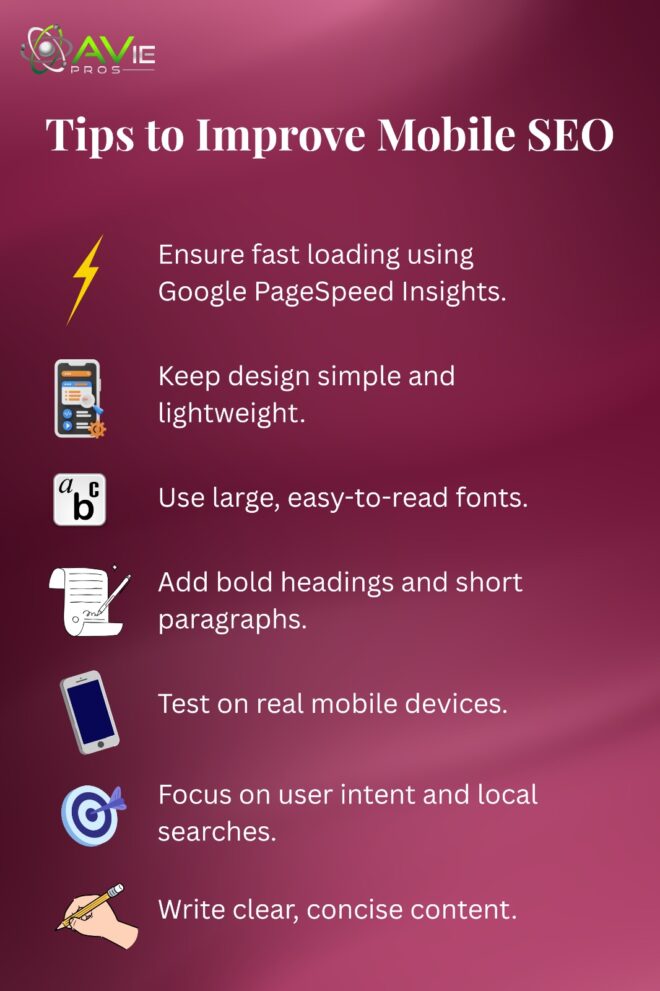
Your design should continue to be simple and light. Make use of simple graphics or none at all. Make sure the fonts you use are big enough to read without changing them. Additionally, to make your information scanable, use bold headings and short paragraphs.
Always use real devices to test your website. Use more than simply desktop previews. Check out how it feels and appears on different phones. Lastly, consider the intent of the user. Users of mobile phones often search for quick responses or local information. Make sure your writing is clear, informative, and short.
The Role of Voice Search in Mobile SEO
Voice search depends on mobile SEO. Instead of typing, the majority of users now communicate with their phones. This suggests that people’s search habits are changing. People frequently ask detailed queries when using voice search, like “Where is the nearest restaurant?” or “How to fix slow Wi-Fi?”
You should write in an organic, conversational style that connects with this behavior. Respond to inquiries directly and in plain English. Additionally, local SEO is becoming ever more important due to voice search. Many voice searches are for quick facts or nearby locations.
If you own a business, make sure your website has a clear display of your address and phone number. Your website will be more visible to the growing number of people who prefer talking to typing if you optimize it for voice search.
The Future of Mobile SEO
No doubt the future is entirely based on mobile search engine optimization. More people will rely on mobile phones for all tasks as they get faster and smarter. Mobile-first experiences are already a focus for search engines. More websites will likely be made for mobile devices first, followed by desktops, in the near future. Design trends will be influenced by interactivity, speed, and simplicity.

Voice search, chatbots, and artificial intelligence will all play a bigger role in improving user experience. Businesses will stay ahead of the competition if they invest in mobile SEO now. Those who ignore it will gradually disappear from view while looking for it. There is no trend in mobile SEO. It serves as the foundation for future success in the world of technology.
Which Tools Can Help with SEO
Many tools are available to help test and improve your mobile website. The Google Mobile-Friendly Test lets you know if your website works on mobile devices. PageSpeed Insights shows you where you can make improvements and how fast your site loads.
Google Search Console can also be used to track user activity and mobile problems. GTmetrix and Pingdom are excellent tools for tracking the speed and functionality of websites. These tools will make it easy to identify the problems and gradually improve your SEO strategy.
Why Businesses Must Focus on Mobile SEO
One of the best investments you will ever make as a business owner is mobile SEO. The majority of users use their phones to find goods and services. You are losing out on real opportunities if your website isn’t responsive. A well-designed mobile website increases sales, builds trust, and moves you up the Google rankings.
Because people view your website as current and professional, it also improves brand reputation. Whether a business is large or small, mobile SEO is important. It enables everyone to access your message, no matter the device they are using. The Benefits of Mobile SEO go beyond rankings they build trust, improve conversions, and make your site more professional.
Conclusion
Mobile SEO is the essential part of your online presence. It is the basis of any effective internet marketing effort. Search engines will continue to favor websites that offer a seamless, speedy, and friendly experience as the number of mobile users rises annually.
You can connect with more visitors, improve your search ranks, and grow your business by understanding mobile SEO and taking the appropriate actions. Maintain the simplicity, speed, and ease of use of your website across all platforms. That is the real secret to mobile SEO success.
FAQs
What is Mobile SEO in simple words?
Mobile SEO means making your website work well on phones and tablets so people can read and use it easily.
Why is Mobile SEO important?
Most people use phones to browse the internet, and Google ranks mobile-friendly sites higher.
How can I check if my site is mobile-friendly?
Yes, you can. Many SEO tools are now mobile-friendly, so the answer to ‘Can I do SEO on mobile?’ is definitely yes.
Does page speed affect Mobile SEO?
Yes. A slow website can make users leave quickly, which hurts your SEO ranking.
What is mobile-first indexing?
It means Google looks at your mobile site first when ranking in search results.
Can mobile SEO improve sales?
Yes. A mobile-friendly website brings more visitors and builds trust, which can lead to higher sales.