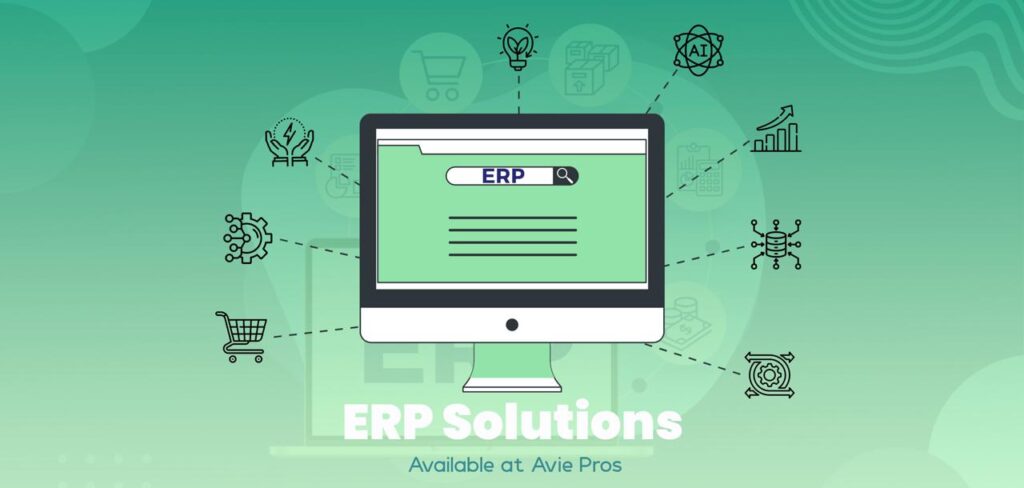
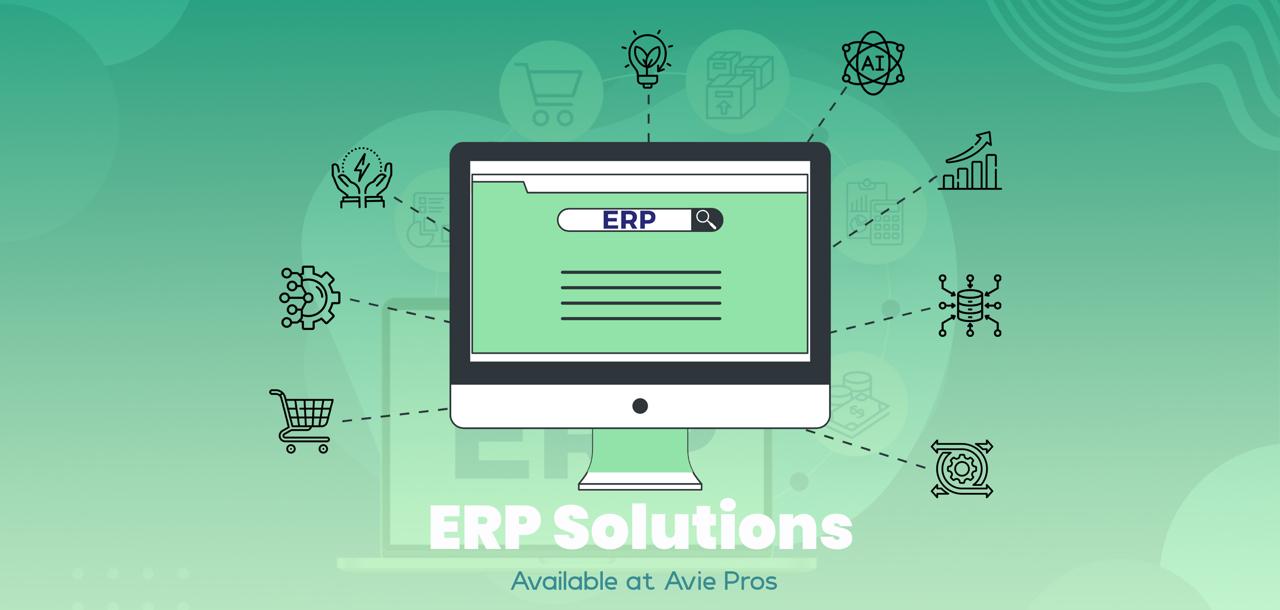
Software known as what is ERP system, or enterprise resource planning. It helps companies in controlling all of their everyday operations. Accounting, sales, purchasing, inventory, human resources, supply chain, customer relations, and more tasks.
An ERP system connects all departments into a single platform that reduces the need for multiple programs to run. Information moves seamlessly across departments in this way. For example, if a new order entered by the sales team can be immediately viewed by the inventory team, recorded by the finance team, and prepared by the shipping team.
To put it simply, what is Enterprise Resource Planning? ERP acts as a company’s brain, tying together all the many components so they function as a whole. Because everyone gets access to real-time information, it enhances decision-making, reduces mistakes, and makes organizations work more smoothly. Let’s explore it:
The History and Evolution of ERP
- The concept of ERP wasn’t introduced quickly. As businesses searched for better ways to operate, they changed over many years.
- Businesses mostly used computers in the 1960s for simple tasks like processing payroll or keeping track of inventory. These were very simple programs that ran separately and could not talk to each other.
- A system called Material Requirements Planning (MRP) was in place by the 1970s. MRP helped manufacturers plan how much raw material they would need to produce items. Because it reduced waste and saved money, this was an improvement.
- MRP developed into Manufacturing Resource Planning, or MRP II, in the 1980s. In addition to materials, this also includes scheduled staff, machinery, and production schedules. Businesses started to see how powerful computer-based planning could be.
- ERP systems later appeared in the 1990s. These were more complex than MRP and could manage human resources, sales, finances, and production, among other things. ERP evolved into a comprehensive solution through combining all corporate operations.
- The use of ERP systems has grown over time. These days, they may be customized, are cloud-based, and can use artificial intelligence to provide insights and recommendations. What started as simple planning tools has grown into complex software that may be used in any area.
Why is Enterprise Resource Planning Important?
Enterprise Resource Planning is important because it helps businesses operate more efficiently and intelligently. What is ERP system in business? It’s a tool that integrates all core operations, enabling seamless communication across departments. Businesses must control expenses, supply products on schedule, and please customers in the modern economic climate. These tasks are difficult without ERP since information is not efficiently shared, and each department functions independently.
The entire company is connected via an ERP system. It gives managers a clear image of what is truly occurring in real time, reduces errors, and gets rid of redundancy. A company may, for example, determine exactly how much inventory it has, how much money it has made, and which orders are still outstanding.
ERP helps businesses grow as well. ERP makes it easier to handle everything in a single system as a business grows into new regions or hires more employees. Additionally, it is required for compliance because most sectors have strict rules that must be followed. ERP makes sure that procedures adhere to the law and keeps accurate records.
How Do ERP Systems Work (All Factors)
What is ERP, and how does it work? A single central database connects a number of modules or applications that make up an ERP system. All of the modules can communicate with each other because they all connect to this database. Usually, each module focuses on a different aspect of the company, such as finance, procurement, logistics, or human resources. The entire business can stay updated and integrated as they all work with the same data.

The flexibility of ERP is one of its advantages. Companies can choose which modules they need at first. As they grow, they can add more. A small business might begin with finance and inventory before adding supply chain management or human resources. Some ERP systems allow organizations to install extensions that provide a basic package, while others provide industry-specific features.
Many business needs are met by the ERP systems in use today. ERP system examples include SAP S/4HANA Cloud, which includes modules for supply chain, manufacturing, finance, sales, and procurement, is one example. ERP is not a stand-alone system. It must interface with other important systems, including ERP systems, e-commerce websites, human capital management systems, and customer relationship management software. It maintains the order to be completely beneficial.
This type of integration gives businesses an overall and complete view of their operations. It enables smooth collaboration between teams and partners, improves client experiences, and streamlines procedures. At Avie Pros, we deal with ERP systems to facilitate and help businesses grow.
The adaptability of the ERP is also visible in how well it connects with other programs. Application programming interfaces that act as virtual bridges for various programs are used by some ERP systems to connect. Others use new cloud-based integration platforms or enterprise service bus technology to interface. The goal is the same regardless of the method to enable real-time data interchange amongst all systems so that the company can make better decisions more quickly.
ERP Examples by Industry
Businesses’ use of ERP systems varies widely based on the industry they operate in. But to compete, any firm, regardless of its type, needs accurate data and smooth operations. ERP gives them the ability to achieve that. Let’s look at how ERP is used in different sectors:
1. Manufacturers
An ERP system in manufacturing is essential for companies. Whether they produce individual goods, batches, or continuous processes. Because the system keeps an eye on every stage of production. It helps them guarantee the quality of the final product. Additionally, it helps control the use of machinery and equipment to prevent overuse, which reduces maintenance costs and downtime.
By controlling overtime, ERP also makes personnel management easier. Manufacturers can have full visibility of inventory. They can track the flow of both raw materials and completed goods. It actually determines which products are in stock and which are not. You can also check the economic plan purchase record. ERP reduces waste and increases efficiency in manufacturing.
2. Retailers
With the growth of e-commerce, the retail industry has experienced significant change. These days, sellers need organized information across all of their sales platforms, including physical stores and online marketplaces. That commonly works together. This integration is provided by ERP.
ERP allows the shop to track in-store sales as well as manage online orders, shipping, and payments. The purchasing experience is improved by this consistency. It increases site sales conversions, reduces missing shopping carts, and even helps to raise the average purchase value. ERP ensures that clients purchase things easily, receive them on schedule, and obtain the correct products.
3. Service-Centric Companies
An ERP system in accounting is critical for professional service sectors like accounting, tax, engineering, and law businesses, which rely on ERP in various ways. Instead of dealing with physical products, they offer services that are dependent on time, money, and expertise. These companies use ERP systems to help with task planning, resource allocation, and project management.
ERP systems also give businesses access to real-time financial data, which helps them identify areas for expansion and assess profitability. Service providers may fulfill deadlines without losing control of expenses thanks to mobile ERP apps, which provide them access to information from any location.
All things need to be considered because ERP helps service businesses balance maintaining their financial stability with producing high-quality work.
4. Utilities
Utility companies, such as those that provide gas, water, or electricity, face unique difficulties. They work with high-capital assets such as networks, machinery, and plants. ERP helps them monitor and assess these assets. It enables businesses to predict future needs and quickly replace outdated trends.
Management of spare parts is another important utility requirement. When a part fails during an outage, it causes delays and unhappy consumers. On the other hand, excess parts lead to more expenses and risks of outdated components. ERP solves this by more accurately forecasting the demand for spare parts, which helps utility companies save money while ensuring uninterrupted service.
5. Wholesalers
ERP is necessary for logistics firms, importers, and wholesalers to keep distribution costs down and operations running smoothly. These businesses are focused on moving goods quickly, cutting down on stock storage time, and speeding up the order-to-cash cycle. Wholesalers can perform tasks like order processing and billing by connecting inventory management with logistics through ERP.

As a result, mistakes are avoided, time is saved, and products can be delivered to customers and retailers more quickly. ERP also gives them the tools they need to better track shipments and warehouse operations, which improves the supply chain as a whole.
Types of ERP Deployment
There is no one right way to put an ERP system into place. Depending on their size, goals, and finances, organizations can implement an ERP system in a number of ways. The four most common kinds are hybrid, two-tier, on-premises, and cloud-based. Organizations must carefully consider each model’s advantages and disadvantages before deciding which is best for them.
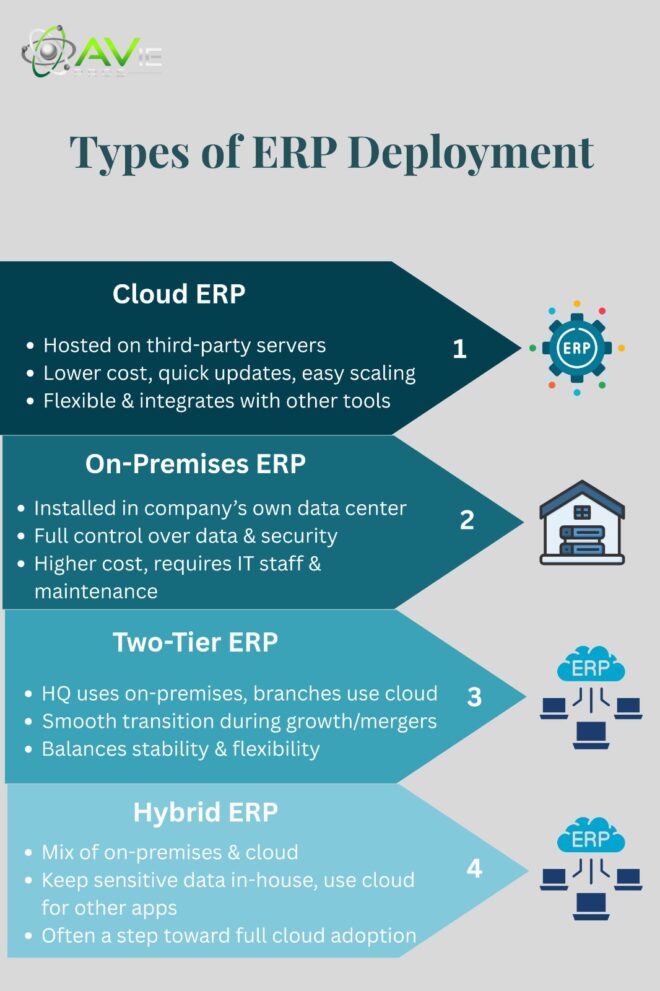
1. Cloud ERP
These days, cloud ERP is the most popular option. This method involves installing the software on remote servers owned by a third party. The business usually pays a membership fee and uses the system online. By taking care of upgrades, security, and maintenance, the provider relieves the company’s IT department of some of its workload.
Cloud ERP offers many benefits. It allows companies to embrace new features and innovations more quickly, scales up easily as the firm grows, and is less expensive to deploy. Cloud ERP is highly flexible because it is also easier to combine with other software programs.
2. On-Premises ERP
The traditional approach to implementing this type of software is on-premises ERP. The system operates internally and is set up in the business’s own data center. This gives the company complete control over the data, security, and software.
However, this control comes with responsibilities. The company will have to handle maintenance, upgrades, and installation on its own. This requires more spending on IT staff and equipment. However, some industries choose on-premises ERP because of strict security or regulatory compliance requirements.
3. Two-Tier ERP
Some businesses use a two-tier ERP approach, especially when going through major transitions like mergers, expansions, or acquisitions. The master firm may use an on-premises ERP at its headquarters under this structure, while the smaller branches or subsidiaries use cloud-based ERP.
With this technique, businesses may gradually move to the cloud without affecting their key functions. While considering cloud solutions for specific departments or areas, they might keep core operations stable. It gives businesses flexibility and improves their ability to manage complex structures.
4. Hybrid ERP
An ERP system that is hybrid combines cloud-based and on-premises implementations. It gives companies the freedom to choose which apps stay on the cloud and which stay in-house. Sensitive financial data, for example, might be kept on-site for security reasons, but cloud-based customer support or sales activities could be used for quick access.
Typically, hybrid ERP is used as a temporary solution before full cloud installation. It is adaptable and makes sure businesses can still take advantage of cloud technology while conforming to industry laws.
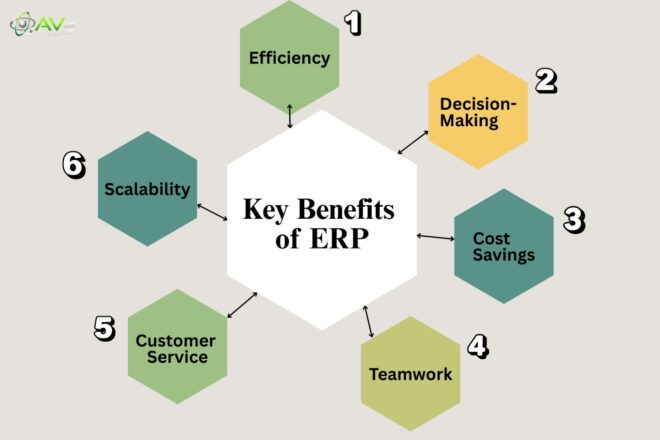
Six Key Benefits of ERP
Systems for enterprise resource planning provide businesses of all sizes with a number of advantages. ERP helps businesses operate more intelligently and effectively by connecting all departments and offering a single source of truth for information. Let’s take a closer look at six of the most important advantages:
1. Efficiency
ERP’s primary benefit is increased efficiency. When a company uses various systems, employees often spend time entering the same data repeatedly, which can lead to mistakes. By combining all procedures into a single system, ERP fixes these problems.
For example, the finance team does not need to re-enter the same data when the sales team places a new order because it has already been stored in the common database. This reduces the amount of human effort, saves time, and keeps the business’s systems accurate.
2. Decision-Making
Better decision-making is the second benefit. If managers are using outdated or incomplete information, they will not be able to make wise decisions. Because ERP updates data constantly and in real time, executives always have a clear view of what’s going on in the company.
They are always able to keep an eye on sales, inventory, and finances. This makes it possible for them to spot problems early, change methods quickly, and create plans with greater assurance.
3. Cost Savings
The third benefit is financial savings. ERP reduces needless expenses in a variety of ways, even if business operations are expensive. It reduces the possibility of mistakes that result in monetary losses, optimizes procedures, and prevents duplication of effort.
Companies that save resources more effectively prevent waste in labor, raw materials, and storage. ERP is an investment worth making because of all these savings that add up over time.
4. Teamwork
Tighter teamwork is the fourth advantage. Since most departments in businesses function independently, it is difficult to share information. Because ERP creates a shared system that allows everyone to view and share the same information, it removes these obstacles.
Teams no longer have to assume what other teams are doing, which promotes trust and cooperation throughout the company. For example, the manufacturing department may plan according to actual sales predictions, and the advertising team can know what items are available before launching a campaign.
5. Customer Service
Better customer service is the fifth benefit. Consumers today need accurate information and quick responses. Customers will look for other suppliers if a business cannot deliver a product on time or is unsure if it is in stock. ERP prevents this by providing real-time data that enables fast order processing and on-time delivery guarantees.
Additionally, it allows customer support representatives to see the full history of orders, which helps to address problems and build long-term relationships with customers.
6. Scalability
The ability to scale is the sixth benefit. As a firm grows, its needs become increasingly broad. Small businesses may start with a few ERP modules, but if they expand into new markets or hire more staff, they may add more features without having to change the entire system. Because of its scalability, ERP continues to support the company throughout its growth. ERP adapts to keep things running well.
How do I know if I’m ready for an ERP System?
To balance their workload, most firms, especially smaller ones, use simple solutions like spreadsheets or accounting software like QuickBooks. Due to their ease of use and affordability, these solutions may initially be sufficient.
However, these techniques become problematic and ineffective when a business grows. They can cause the company to stall, make reporting more difficult, and prevent the company from growing smoothly. In the long run, relying only on these discrete instruments may affect progress. In that case, a modern ERP system is the better choice.
1. Routine Tasks
Spending too much time on standard procedures is a clear sign that a company is ready for ERP. Too many different apps may be the cause if routine operations like inventory management, closing the books, and preparing invoices for payment are taking longer than they should.
By combining everything into a single system with a single interface, ERP resolves this problem. Departments may interact more readily in this way, and employees can focus on their actual task instead of wasting time on other tools.
2. Data Access
The difficulty in obtaining important data is the second indicator. When asked important inquiries, such as how much money a product category generates or how many returns were processed in the previous month, executives usually demand answers very quickly.
It usually means that the systems are not sharing data correctly if getting this information is considered to be difficult, slow, or even impossible. ERP makes this possible by organizing all company data and providing real-time access to metrics, reports, and performance indicators.
3. Process Issues
Some companies also recognize that managing their procedures is becoming more challenging. These could appear as ineffective inventory control, rising expenses, or trouble meeting client demands. It is typically a sign that the company has surpassed its current systems when procedures start to escape managers. ERP enforces discipline and makes it possible to redesign procedures to better suit expanding and changing corporate needs.
4. No Standardization
The lack of standardized processes among departments is another common problem. There is a risk of repeated errors, delayed reporting, and redundant data entry if each team uses different tools and processes.
As an example, the finance team may enter client data in one program while the sales team enters the identical data in another. In addition to taking up time, this duplication complicates decision-making. ERP addresses this by reducing errors, preserving consistency, and offering a single central database that is used by all departments.
5. Missed Opportunities
The final sign that a company could need ERP is if too many opportunities are going ignored. Employees may lack the strength and resources to seek new products, markets, or ideas if they spend all of their time just keeping the business running.
Smart tools like machine learning and predictive analytics, which may identify trends and suggest profitable possibilities, are also included in modern ERP systems. Instead of struggling with legacy systems all day, businesses can use ERP to free up time for innovation.
In other words, if your company is slowed down, overloaded, or unable to respond promptly because of disconnected tools and procedures, it is likely time to switch to ERP.
Things to Look for in an ERP System
- Choosing to use an ERP system is a serious matter. Decisions should be made regarding cost, security, adaptability, and ease of usage. The system must have components that are appropriate for your company and be flexible enough to grow with it.
- Integration is another essential component. Your present equipment, including email, customer management systems, and e-commerce platforms, must seamlessly interface with the ERP.
- Training and support are also essential. A reputable ERP supplier will help your staff become proficient with the system and offer excellent customer service.
- Additionally, you should confirm if the ERP is physical, cloud-based, or hybrid, and then select the one that best suits your needs.
- Finally, always look for ERP systems that have excellent reviews for your business. It will better suit your needs and business strategy as a result.
The Future of ERP
ERP systems are still improving. ERP is getting smarter thanks to new technologies like machine learning, artificial intelligence, and the Internet of Things. These computer programs predict demand, recognize dangers, and even suggest better business plans.
Additionally, mobile access is growing in popularity so that managers and staff can use ERP on their tablets or smartphones. ERP will become increasingly more integrated and user-friendly in the future. Because of its visible growth, Avie Pros collaborates with this and offers ERP services.
Avie Pros Offers ERP
ERP is a problem-solving system and helps millions of people grow their businesses to the next level. As a trustworthy system, Avie Pros joined it and offers its services to all. You can easily contact the Avie Pros team. You can ask for guidance, offers, and clarify your confusion by contacting us. Build a successful journey with us as we take care of our clients’ concerns. Welcome to the ERP journey with us!
Conclusion
ERP, or enterprise resource planning, functions as a company’s nervous system that handles connecting the activities of all departments. It provides accurate information in real time, clears up confusion, and saves time. ERP ensures that every department, from sales to finance, inventories, and customer service, is linked and controllable.
It is not just a helpful tool but also a need for growing companies in order to stay competitive, increase productivity, and make better decisions. As technology advances, ERP systems will become increasingly more intelligent and straightforward in the years to come. It will make business management easier.
FAQs
What does ERP stand for?
ERP stands for Enterprise Resource Planning, which is a type of software that manages all core business processes in one system.
Is ERP only for big companies?
No, ERP can be used by small, medium, and large businesses. Today, many providers offer ERP solutions designed especially for small businesses.
How long does it take to set up an ERP system?
The time depends on the size of the company and the complexity of the system. It can take a few months for small businesses and up to a year or more for large enterprises.
Can ERP replace human workers?
No, ERP is not meant to replace people. It is meant to make their work easier by automating routine tasks and providing better information.