If you are wondering about to know the difference between UX vs UI design, then you are not the only one who’s seeking. These two designs I reliable and well-reputed, but frequently they have various things that can make them different. UX design is very easy and understandable. It provides valuable research according to user needs and maps with a logical structure for your product.
On the other hand, UI design focuses on the basic visuals and interactive elements of your product. This is the best thing in this creative digital product era because you are designing works amazing. Let’s understand what is UI design and UX design are.
Difference Between UX vs UI Design
To understand UX versus UI design, we need to know its full form first, so we can take the idea about its working. UX stands for “user experience design,” and UI stands for “user interface design”. You must think about why UX and UI exist, for what purpose they can be used, and what the difference is both them. Let’s understand together the difference between UI and UX with example:
Difference 01: What are UX and UI?
UX and UI both help create websites, apps, and software. Let’s break down both times with a sequence:

Part 01: UX Design
The UX design maps out the user’s overall experience, providing a product journey. UX design covers the solutions for the user who is going to create a new product. When a person starts their journey of creating your product, they might face a lot of consequences. Those errors and problems can be recovered by using UX design. It includes such features and functions that are user-required within the product.
If the user is worried about a roadmap for making a product, then it can be mapped out and give your structure of the product. You can easily organize your product with logical information and authentic content. It’s just possible because of the impressive quality of UX design. Let’s dive into the details of why are UI and UX often used together:
1. What’s the User Experience (UX Design)?
The User experience design is the first way to design different products. A scientist called “Don Norman,” and a co-founder of the “Nelson Norman group design consultancy,” both gave the term user experience in the 1990s. In their words, they describe the user experience as: looking for all aspects of the product with its services, company dealings, and potential.
The UX design works for all products, it could be a lamp, a car, shelving, or anything. UX design totally goes for the digital field and allows users to work progressively in the tech industry.
You can take a complete guide from UX design for your website, supermarket, a coffee shop, or even a machinery product. It will give you multiple designs with different elements and shapes. Now it’s up to you to design it in your way or consider the direct idea of UX design.
2. What Does UX Design Involve?
A UX designer considers the way of experience, what the user feels. And how simple it is for the user to get what they want. They also watch and do task analysis to observe how users really do things in a user flow.
For Example, how convenient is it to check out when you shop online? How convenient is it for you to hold that vegetable peeler? Is it convenient for you to use your online banking application to handle money? The final goal of UX design is to build convenient, effective, relevant, and overall enjoyable experiences for the user. Here’s what you should know about UX design in a nutshell:
- User experience design is the process of creating and enhancing the quality of interaction between an individual and all aspects of an organization.
- In theory, user experience design is a non-digital (cognitive science) discipline, but practiced and defined by digital users mostly.
- UX design is not about the looks; it’s about the overall product design experience.
3. UX Designer Tasks and Responsibilities
The basic things we need to understand about why a UX Designer works and what tasks and responsibilities they perform? The answer is that US designers do multiple tasks for everyday ease. There is a list below that covers the responsibilities of a UX Designer. Let’s get into:
1. Strategy and Content:
A UX designer analyzes the competitors of their product. They want to rank their product on the social media platforms, so they understand the working strategy of their competitors to beat them well. They also work on the analytics to understand the customer demand and the user research.
These are the most powerful facts on your behalf that you can use to make your product a winner. Determining what structure and strategy are suitable for your product is a task that UX designers do. They also create content for their product to make it socialize.
2. Wire Framing and Prototyping:
The UX designer also handles wireframes, prototyping, and the testing of the product. They work on the development of the product and plan its complete road map.
To make your product according to users’ needs, you need to test a lot to give it a better version. It’s a powerful responsibility of the designer who works on a product.
3. Execution and Analytics:
It’s not compulsory that only UX designers can complete the product journey alone, they also need coordination with UI designers. They need to coordinate with the developers to track the goals and progress of the product. Working on analytics and designing is the role of a UX Designer.
We have mentioned the overall duties of a UX Designer that are challenging and complex to handle.
Part 02: UI Design
You are design is useful to consider the interaction of using the product. It works for the screen, touch points, and the pages. The fact that it meets the needs of the user that a person looks for. Likewise, it includes considering elements of the product like images, toggles, navigation, menu, buttons, and scrollbars.
A user can easily take the idea of where the elements should be positioned and what the visual hierarchy is that matters for a clean and optimal layout. UX design matters a lot and deals with the clicks and screen connect of the product. You can also learn the interface customization to enhance the visual appeal of your product. It usually depends on vision, color schemes, and font style.
1. What’s User Interface (UI) Design?
The topic “What is user interface design?” is challenging to answer because of its wide range of misunderstandings, even though it is an older and more developed field. User interface design is a product’s complement, its appearance, feel, presentation, and interactivity. Whereas user experience is a collection of activities that focus on optimizing a product for efficient and beneficial usage.
A Lot of people that confused about the UI and UX designers. But the profession and your posting are frequently different for both. You are working on a digital product, such as touch touchscreen on your smartphone or the touchpad for your product. Likewise, if you are running a coffee shop, then the touchpad must be connected to the coffee maker, where you can select the coffee menu by tapping on it. It’s called a user interface.
UI design for websites and apps takes into account the product’s appearance, feel, and functionality. It all comes down to making a product’s user interface, which involves providing careful thought to every visual and interactive component the user may come across.
2. What Does UI Design Involve?
Similar to user experience design, user interface design is a complex and demanding field. It is in control of transferring the development, research, content, and layout of a product into an engaging, leading, and responsive user experience.
UI design can be described as follows:
- The practice of user interface design is exclusively digital. It takes into account all of a product interface’s visual and interaction components, such as buttons, icons, spacing, typography, color schemes, and responsive design.
- UI design wants to visually lead the user through the interface of a product. Creating an intuitive experience that doesn’t require the user to think too much is the main goal.
- To ensure that a product’s interface is consistent, logical, and visually appealing, UI design uses the brand’s visual assets and strengths.
3. UI designer Tasks and Responsibilities
You could be more interested in UI design if you enjoy the idea of making amazing user experiences, yet consider yourself to be a more visual person. You’ll find a brief picture of the UI designer’s primary activities below, or a more detailed explanation of what a UI designer performs in this guide.
The look and feel of the product:
- Analysis of customers
- Research on design
- Graphic design and branding
- Storylines and user manuals
Responsiveness and Interactivity:
- UI prototypes
- Animation and interaction
- Responsive or adaptive design that adjusts to the screen sizes of all devices
- Working with a developer to implement
The UI position, as a visual and interactive designer, is essential to any digital interface. It’s a major factor that builds trust in a company. While the UI designer is never completely in charge of the brand itself, they are in charge of how it is translated into the product.
We can say that the web designers also provide the website-making concepts, which are similar to a UI designer. It is a powerful job because a lot of people are seeking for professional UI designer to make their businesses successful because they know how to deal with the user interface of websites.
Difference 02: Comparison with Chart and Logics
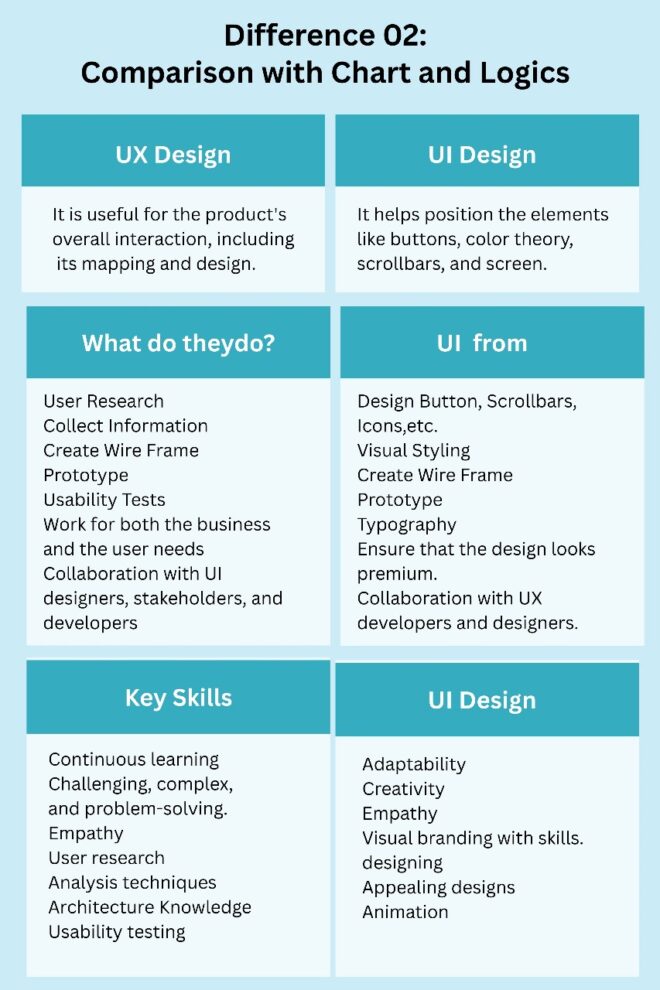
1. Choosing between UX and UI
You should take some time to consider your hobbies and your natural skills if you want to work in design but aren’t sure whether to concentrate on UI or UX. Both UI design and UX are very collaborative, vast job options that put you at the top of innovation and technology.
Having said that, there are a few important differences between the type of work and the abilities needed. Understanding, a love of solving problems, and a creative yet analytical mindset are all necessary for a job in user experience. Excellent communication skills and a small amount of business knowledge are also essential for UX designers.
2. Becoming a UI/UX Designer
While they differ in other ways, becoming a UI or UX designer necessitates comparable methods. Here are several requirements and strategies to increase your chances of success:
- Enhancing your abilities
- Being familiar with industry tools
- Building a portfolio
- Developing your brand
Education is the greatest and most reliable place to start, just like with other else in life. Although becoming a UI/UX designer can theoretically be completed without formal education, receiving training will greatly improve your chances of success in the industry. Thankfully, there is a wide variety of free online courses and content available for these talents.
3. Key Takeaways
I hope that the article has helped to clarify the long-standing misunderstanding between UX vs. UI. There is much more to both UX and UI than what we have discussed today, so it is important to read up on each topic carefully to gain a better sense of what it involves and how it differs from the other.
Difference 03: Most Important Queries
There are a lot of questions that people are looking for and want to know about UX vs UI. Let’s crack all the details and make a clarification on the differences:
1. Where do UX & UI Fit Together?
In this guide, I will give you a proper road map where the UX and UI designer works combine to develop a perfect product. Let’s discuss:
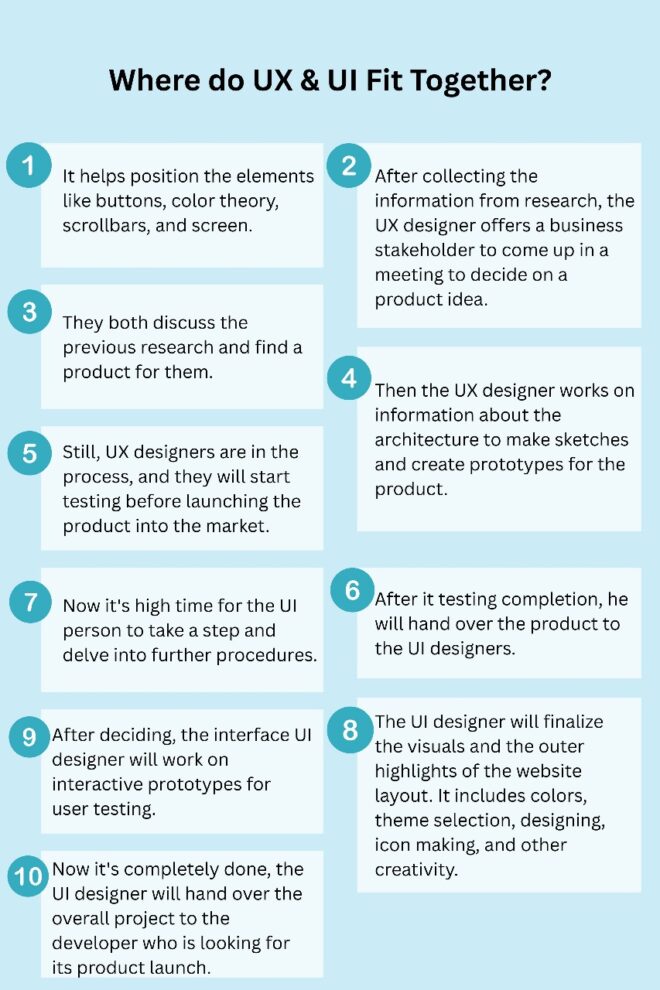
- Initially, the UX designer researches to understand the needs of users.
- After collecting the information from research, the UX designer offers a business stakeholder to come up in a meeting to decide on a product idea.
- They both discuss the previous research and find a product for them.
- Then the UX designer works on information about the architecture to make sketches and create prototypes for the product.
- Still, UX designers are in the process, and they will start testing before launching the product into the market.
- After it testing completion, he will hand over the product to the UI designers.
- Now it’s high time for the UI person to take a step and delve into further procedures.
- The UI designer will finalize the visuals and the outer highlights of the website layout. It includes colors, theme selection, designing, icon making, and other creativity.
- After deciding, the interface UI designer will work on interactive prototypes for user testing.
- Now it’s completely done, the UI designer will hand over the overall project to the developer who is looking for its product launch.
According to a well-known personality, the UX & UI designs are:
He says that UI without UX is like a painter who paints on a canvas without any thought. He just paints, and everything looks like a mess. Both are pillars of a product’s success, so we can’t achieve a great painting without having a UX designer.
So, it’s really important to consider why UX and UI work together and why they need to do it. We can’t say that we can replace one of them and compromise on one designer’s skills.
2. Why do Companies Often Advertise UX/UI Roles as One?
We now know that UX and UI are two different areas. So, you might be asking: why do so many job ads look for a User Interface vs User Experience designer in one role?
The reason is that UX and UI are still quite new fields, and they are mostly known in the tech industry. Outside of design and tech, many people still don’t fully understand them, even though they are very important for business.
More companies are starting to see the value of good design, but many hiring managers still think one person can do both UX and UI. This is why you see many job ads combining them. Sometimes it’s not just a misunderstanding. Some companies want to hire designers who can handle both UX and UI, or at least have basic knowledge of the other area besides their main skill.
So, how can you know what the job involves? Whether you want a role only in UI, only in UX, or a mix of both, don’t just look at the job title. Check the skills, tasks, and responsibilities in the ad, just by scrolling down to see the description details. Now that you understand the difference between UX and UI, it will be easier to tell if a job is focused on one, the other, or both.
3. UX vs. UI Salary?
There are numerous factors, on what salary depends likewise:
- Experience and location of industry
- Type of project or product
The pay ranges for UI and UX positions in the US are generally comparable for both startups and major tech companies. However, it’s worthwhile to look at businesses individually. Based on averages (updated for 2025), you can check how UX and UI salaries compare in the US here:
Salary differences between UI and UX designers:
UX Designer: $82,683; UI Designer: $93,981;
Junior UX Designer: $78,540; Junior UI Designer: $73,454
$117,223 for the senior UX designer and $121,734 for the senior UI designer.
4. Why do we need both UX and UI design?
While UI ensures that the product is beautiful to look at and easy to use, UX ensures that the product fulfills the needs of the user and functions well. When both are combined, the end product is practical, enjoyable, and simple to use.
5. What are the key differences between UX and UI design?
The user’s total experience is the main focus of UX design, which makes sure that the product is easy and simple to use while also meeting users’ needs, goals, and expectations. Usability testing, wireframe creation, information architecture definition, and user research are all part of UX. The visual and interactive aspects of the product are the main focus of UI design. It involves developing each screen’s layout, functionality, and appearance (such as color, icons, and font).
6. Is it better to be a UX or UI designer?
Depending on your interests and skill set, you can choose between a career in UI or UX. People who like research, problem-solving, and cross-functional teamwork are good candidates for UX design. For people who are creative and interested in visual design in a digital setting, UI design is perfect. Both positions are very fulfilling, and becoming a versatile design expert can be achieved by mastering both UI and UX skills.
7. Who earns more, UI or UX designers?
Location, experience, and business size all affect UX and UI designers’ pay. Because of their greater concentration on user research, strategy, and problem-solving, UX designers typically make a little more money. However, particularly in design-driven sectors, skilled UI designers who are skilled at producing beautiful and interactive interfaces can command high salaries.
Wrapping Up
In conclusion, whether a product is a website, an application, or even a physical item, UX and UI design are the two most important parts of its creation. Understanding user needs and making sure the product is simple, practical, and pleasurable to use are the main goals of UX design. It all comes down to resolving issues and supporting a smooth and simple customer experience.
However, user interface design involves how the product appears and feels, including the selection of colors, fonts, buttons, and the placement of things on the screen.
A product that is both useful and attractive is produced when UX and UI collaborate effectively. Because the product is attractive and easy to use, this combination results in happier customers and helps businesses grow. For anyone who wishes to produce excellent goods, it is important to understand both UX and UI and how they connect.
Frequently Asked Questions
What is the main difference between UX and UI design?
UX design involves how a thing functions and how user-friendly and pleasurable it is. The way a product appears and how customers interact with features like buttons and menus are both aspects of user interface design.
Can one person do both UX and UI design?
Yes, especially with smaller projects, one person can manage both at times. But normally, UX and UI are done by separate people because they demand different abilities and ways of thinking.
Is UX design only for websites and apps?
No, a website, a car, a coffee maker, or even a supermarket can all benefit from UX design. The goal is to make things better and easier for people to take advantage of.
What kind of work does a UX designer do?
UX designers research to learn what users want and need. They plan how the product will work, make simple sketches called wireframes, build prototypes to test ideas, and check if users find the product easy and enjoyable.
What kind of work does a UI designer do?
UI designers focus on how the product looks and feels. They choose colors, fonts, buttons, icons, and layouts to make sure the product is attractive and easy to interact with.
How do UX and UI designers work together?
UX designers usually start by researching and planning the product’s structure and flow. Then, UI designers take those plans and design the visual style and interactive elements. Together, they make sure the product is both easy to use and looks great before developers build it.