

UX strategy describes the long-term approach required to ensure that users have access to any product or service in a quick, easy, and enjoyable way. It is a complete approach to a design-based project. It targets the group’s needs, desires, and new trends.
Businesses can enhance customer satisfaction, engagement, and retention by implementing an effective UX strategy. Design choices should go perfectly with user expectations. The company’s mission can be fulfilled through UX. Let’s explore it:
Key Elements of UX Strategy
Understanding your users, setting specific goals, doing competitive analysis, defining success metrics, and developing a strategic roadmap are all important aspects of a successful UX strategy. You may better understand the needs and problems of your audience through performing user research.

Everyone engaged agrees with the product’s purpose when there are defined goals. Through competitive analysis, you would be able to find out what is successful in the market and where opportunities exist. Success metrics reveal how much potential your product has to satisfy customer requirements. The steps for development are explained in this action plan.
How to Create a UX Strategy
The first step in developing a successful UX strategy is gathering information. Use surveys, interviews, or usability testing to gather information about the requirements, preferences, and problems of your target audience. Next, clearly describe the aims of your product or service so that they are in line with both user needs and business objectives.
Next, plan the user journey to identify important interaction points and touchpoints. Finally, rank features and enhancements according to how they will affect the user experience. Throughout the process, test, refine, and iterate to ensure that your plan remains useful and successful.
Core Components
The components are essential for a UX strategy. It includes vision, business goals, user needs, value innovation, focus area, activities, and measurements. Let’s have a look to understand well:
1. Business Goals
Developing an excellent product is only one part of a successful UX strategy; it must also be compatible with company goals. Companies spend money on UX to improve conversion, boost customer loyalty, and make their products more usable. Design teams make sure that every design choice they make supports greater company targets by combining UX strategy with business goals.
For example, if one of the main business goals is to increase user engagement, the UX strategy should be able to offer accessibility and ease of use to promote more frequent interactions. The results are always measurable, and the return on investment is typically important when UX and business outcomes are strongly linked.
2. User Research
The base of any successful UX approach is user research. It offers a very basic understanding of the user’s features, problems, and interactions with the product. A variety of techniques, including surveys, analytics evaluations, and interviews, may be used in user research. These exercises provide insights that inform design choices.

It guarantees that they are based on actual user demands rather than assumptions. Businesses may naturally create products that address real-world issues and improve overall experiences by involving users in the process from the start. In a user-friendly approach, this is how things may be both useful and enjoyable to use.
3. Design Process
The design process is directly affected by UX strategy, and if particular targets have been set and user demands become clear, the process becomes more targeted and focused. Prioritizing design choices with the help of a UX strategy guarantees that the most important functions and interactions are included first.
The strategy provides the designers with a clear vision and guiding principles during the design process. This facilitates the maintenance of reliability across all design elements, from wireframes to final prototypes. In order to improve the user experience overall, it also keeps the design focused on users, addressing any issue that comes up during their involvement with the product.
4. Measurements
Tracking a variety of targets, such as user engagement, retention rates, conversion rates, or satisfaction scores, that are related to both user happiness and business objectives, is necessary to assess the effectiveness of a UX strategy. By setting measurable objectives at the beginning of the project, you can monitor the product’s development and analyze whether the strategy is having the expected effect.
Additionally, helpful insights into areas for improvement may be obtained through analytics, usability testing, and ongoing user feedback. As a result, regular review and modification based on these key performance indicators will guarantee that the UX strategy stays successful and in line with changing user requirements and company goals.
5. Value Innovation (Prototyping)
While it enables designers to test and confirm their ideas before actually creating them, manufacturing is an important part of the UX strategy. A product design can range in detail from a detailed animated design to a simple sketch. Teams can save resources and reduce their chances of spending time and money on usability issues by developing a design early on.

By providing a clear picture of the product’s functionality and user flow, prototyping facilitates communication between designers, developers, and stakeholders. Prototyping is important for UX strategy since it allows for the testing of concepts and the collection of feedback that can be used to improve the design.
6. Alignment
A strong UX strategy must also combine usability and design with content planning. From product descriptions to instructional writing, content plays a very important part in the user experience. For an enjoyable experience, the tone, voice, and message of the content should highlight the main components of the design and the main goals of the user.
This helps companies ensure that the product’s content is clear, brief, and useful to the consumer, assisting them in exploring it. When information and design are seamlessly combined, the product’s usability and value are improved.
7. Activities (Design Process)
User experience covers both functional features and the user’s feelings. Users’ interactions with the product will be greatly affected by their emotions. When a user finds an unexpected feature, they are usually pleased or frustrated when an error is displayed. There are a lot of emotions involved in the UX.

Every interaction’s emotional impact is taken into account by a smart UX strategy. The possibility that people will become loyal customers increases when you develop a design that makes them happy or enables them to trust the service. In order to ensure that this resonance goes beyond simply satisfying user demands, emotional design should be taken into account very early on.
8. Focus Area (Engagement from Other Platforms)
The many platforms and devices that the product will be used on must be taken seriously when creating a UX strategy. The mobile, desktop, and tablet environments will be quite different as a result. The special features of each platform will be taken into account in a successful UX approach, guaranteeing responsiveness and usability across devices.
For example, a desktop application might have more complex features and require mouse navigation, but a mobile application would need to be considerably simpler with touch-friendly interactions. What helps to a seamless experience is making sure that each platform’s unique requirements are always fulfilled.
What’s the Biggest Challenge in UX Strategy?
People are worried about knowing the most challenging aspect. The answer is that managing the stakeholders’ expectations is very difficult in UX strategy. Because you are designers and researchers who only focus on delivering the best experience, but you don’t consider the interest and let business priorities aside.
Stakeholders are the real heroes who maintain a balance of business in UX strategy. The key to being straight is clear communication and regular updates. These are very helpful to align the expectations between design teams and the business leaders.
It’s very important to educate the stakeholders; we need to focus on designs and leads. When they are educated, they will have a better understanding of business outcomes. This thing involves some involvement in the procedure and provides data-driven results. It also ensures that your UX strategy definitely supports both user needs and the business goals.
What’s the Impact of Accessibility in UX Strategy?
A lot of people ignore accessibility and don’t consider it. This is the biggest mistake they ever made because the products are totally useless if you don’t align your design with accessibility. A product depends on various aspects like visuals, management, and much more. If we implement accessibility features in the right manner, we can actually achieve a lot more. Accessibility can be better if we ensure that the screen reading is accurate, the compatibility is great, the keyboard navigation is perfect, and the colour contrast adjustments are best. The design of the page on mobile phones and laptops should be user-friendly. Accessible designs not only improve the experience of individuals but also enhance the overall usability.
Why Implementing UX Strategy Seems Difficult?
Why do people think that implementation is very difficult in UX strategy? I think one of the main reasons is buy-in from stakeholders. It gets so frustrating, especially when they don’t understand the value of user-centred design. If you are trying to balance user needs along with business goals that it could be tricky.
One more challenge is to ensure consistency on different platforms. It requires coordination between design development and teams. UX strategy only works when your team and the developers work combine. The best advice is always to go with your plan and strong communication. By following your proper road map, you can definitely overcome issues and become a successful UX strategy builder.
Importance of Cross-Disciplinary Collaboration
A successful strategy always requires teams across the organization. When are company works with designers, product managers, developers, marketers, and business leaders, there must be discipline. Only cross-disciplinary collaboration shows that the product will definitely touch the level of your goals.
For example, the product managers always provide market trends; on the other hand, developers work on technical feasibility. If one person doesn’t perform with total potential, your innovation can be stuck into high risk. Not a single person’s effort gives results, but the team can create more innovative and 100% working strategies.
Importance of UX Strategy in Product Development
A well-defined UX strategy is like the backbone of your product development. It helps you to maintain the design and the functionality of the User experience. Without a strategy, a product can and up with great features but a poor UX. It doesn’t mean that your product has no great values, but if your strategy or way of presentation is not good enough, then you would definitely end up with frustration.
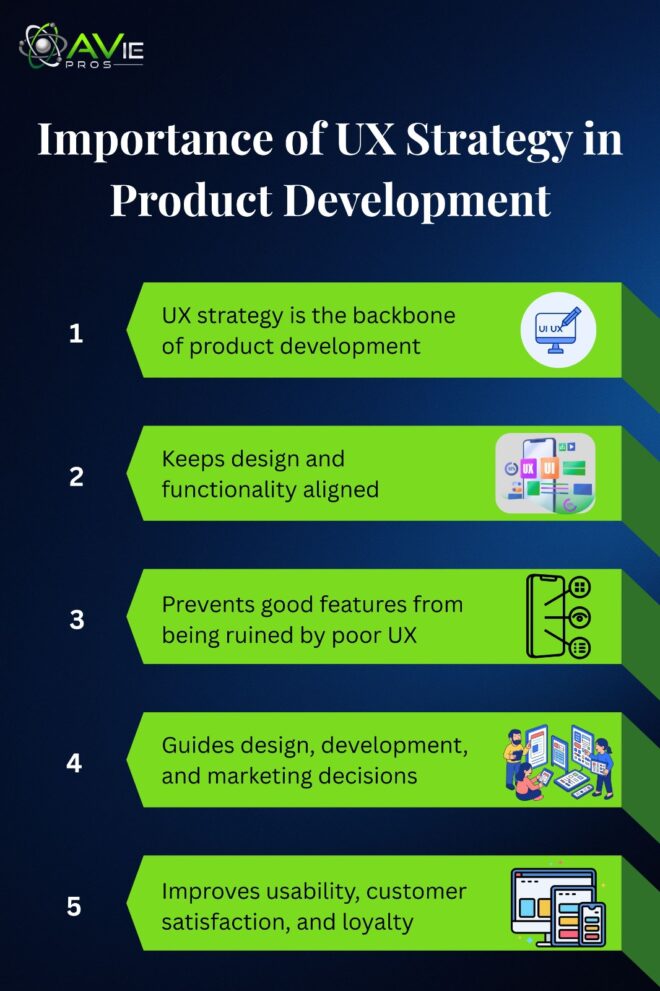
On the other side, a UX strategy is the four fronts of your product; it guides you about the design, development, and marketing. At the end of the day, the product becomes user-friendly and attracts higher customer satisfaction with loyalty.
The Future of UX Strategy
UX strategy is like a technology for your product. We all know that there is no future for product selling in the market without using technology. The future can be secure with the help of artificial intelligence, voice interfaces, and virtual reality (VR).
All the advanced options can bring new opportunities and quite excellent results. The game is not as simple as it seems. You need to put a lot of effort and face unique challenges to be perfect. Additionally, with proper guidance and steps, a user can expect a great experience.
Final Thoughts
In conclusion, we have explained what is UX strategy is in simple wording. The final thoughts are, there’s only a need for the right decisions that can totally align with your product business and other objectives. You don’t need to focus on useless things; always look for your product should is functional and also has a delightful impact.
Strong UX strategy involves understanding your audience, setting clear goals, conducting full market research, and taking continuous feedback from customers. Don’t ignore the implementing strategy, engagement, user satisfaction, and business outcomes. Always find a better way to use the technology, it will ensure your products continue to meet the requirements of a user, and your business will be successful as it should be.
FAQs
1. What is the difference between UX design and UX strategy?
UX design means that you focus on the visuals and interactive aspects. It could be the product colour, the layout of the website, and the theme. On the other hand, UX strategy is a long-term plan. It involves research, goals, proper planning, and understanding user needs.
2. How do I start creating a UX strategy?
Always start by conducting data from detailed research. The priority should be to understand your audience and what they are looking for. If you don’t know but kind of audience you are targeting time you will totally fail. Try to write down your clear goals; don’t add irrelevant objectives. Start writing from the beginning of all the necessary steps. Don’t skip the design outline, development planning, and testing phase.
3. How do UX and business goals align?
It is one of the most important factors. UX strategy helps you to understand the user need and is totally connected to the company’s objective, that’s how your business progress works. It also assists you in driving your business outcome. After implementing, there would be high chances of getting more conversions, customer loyalty, user retention,and product success.
4. Why is user research important in UX strategy?
User research is essential it actually elaborates the behaviour, needs, and challenges. You can easily be aware of what kind of issues you are going to face throughout your journey. It also informs you how to make the decisions about design and how you need to finalize the product. User research teaches you leading guide with better satisfaction and engagement.
5. What are some common challenges when implementing a UX strategy?
Common challenges include gaining buy-in from stakeholders, balancing business goals with user needs, maintaining consistency across multiple platforms, and continuously adapting the strategy based on user feedback and data.