In the current situation, e-waste is turning into a major issue. Without thinking twice, people buy new devices and throw away their old ones. This results in a huge amount of waste that harms the environment. A lot of people are unaware of the environmental effects of wasted electronics. Gadgets quickly become outdated due to the fast development of technology.
This results in huge waste that has never been seen before. Both human health and the environment may be affected by improper e-waste disposal. People can become more aware of their responsibilities by learning about e-waste. This blog post uses simple words to describe the concept of e-waste and how we may address the problem. Let’s explore it:
What is E-Waste?
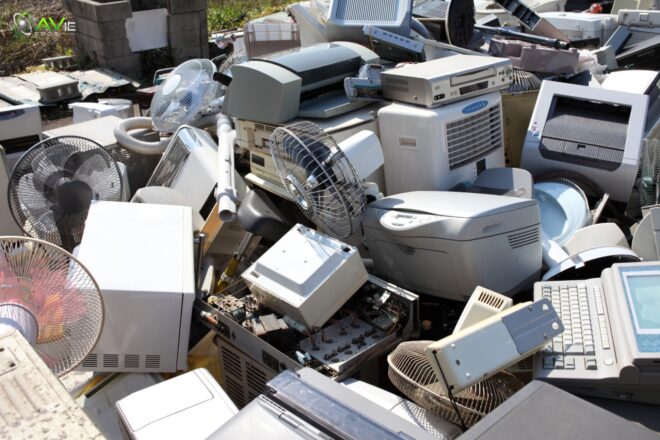
Electronic garbage is commonly known as “e-waste.” Electronic devices that have been used but cannot be reused are the source of this garbage. Televisions, laptops, phones, and other electronic devices are examples of devices. They are thrown away by their users after they stop using them. The e-waste issue is that it differs from regular waste. It features a few unique parts.
While certain components might be useful, others might be dangerous. People’s frequent device changes are the reason e-waste keeps increasing. When new models appear, devices that might still be useful are removed. Understanding the true importance of e-waste is important. People will be better able to make decisions as a result. People can make good decisions when they are aware of what e-waste is.
Common Examples of E-Waste
Many of the devices we use daily turn into e-waste. For example, if an old cell phone is still working, customers regularly upgrade to newer versions. When computers, laptops, and desktop models become old or slow down, they become e-waste. Both musical systems and television radios end up being e-waste.
Kitchen appliances, including microwaves, electric kettles, chargers, batteries, and wires, are examples of additional e-wastes that go unnoticed but end up being e-wastes. Nearly every home has one of these devices. This explains why people are still unaware that these devices can be harmful.
Why E-Waste is Increasing?
The process for disposing of e-waste is increasing as a result of human behavior and technological advancements. Every year, new technology with enhanced functions is released. Even though their current technology is functioning perfectly, some feel the need to upgrade it. Additionally, advertisements have a major role in motivating customers to make larger purchases. The technology is designed to be short-lived.
They also become expensive or challenging to fix. Additionally, this pushes people to choose disposal over repairs. Another factor that causes the issue is the expanding population. More people and more technology disposal result from a larger population. Lack of awareness additionally adds greatly to the issue. When people throw out technology in the regular trash, they are unaware of the harm they are causing.
What Materials Found in E-Waste?
E-waste contains a variety of items. While some are dangerous, others are very helpful. Copper and aluminium are metals that are commonly used. Certain devices may also include modest amounts of gold and silver. Another important part of electrical trash is plastic. It contains dangerous chemicals in addition to valuable materials. These consist of cadmium, lead, and mercury.
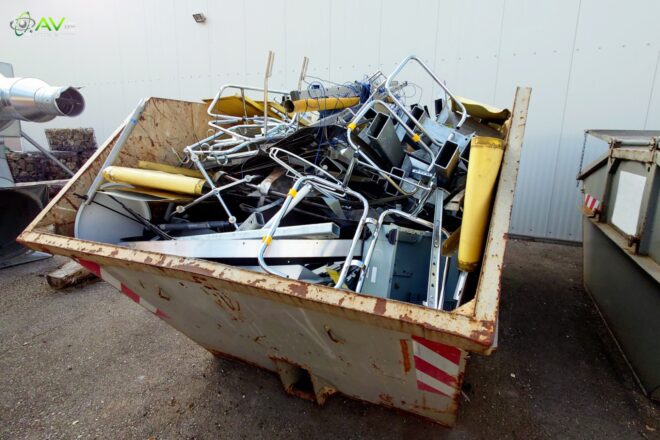
If they are not treated correctly, they seep into the environment. These materials produce pollution when e-waste is burned or thrown away. Many people are unaware of what’s inside their devices. People can better understand why e-waste requires special management and should never be combined with normal household rubbish by learning about these items.
How E-Waste Harms the Environment?
When waste is improperly disposed of, it seriously harms the ecosystem. Chemicals seep into the ground when devices are disposed of in garbage. Plants and crops are harmed by this. These chemicals are carried to rivers and lakes by rainfall, polluting the water and killing fish and other aquatic life.
Burning garbage causes climate issues by releasing harmful smoke into the atmosphere. When animals come into contact with polluted land or water, they die. The restoration of the environment’s health takes many years. In order to preserve the environment and maintain a healthy planet for future generations, it is important that e-waste be reduced and handled properly.
What are the Effects of E-Waste on Human Health?
Human health is affected by e-waste in many different ways. There are serious issues for those who live close to the disposal areas. Food, water, and the air are all affected by the dangerous compounds found in e-waste. Inhaling polluted air can lead to lung illnesses and breathing problems. Internal organ damage could result from drinking water that is polluted. Since their bodies are still developing, children are most impacted.
Without proper protection, workers handling e-waste suffer from skin issues and nerve damage. Cancer may result from long-term use. Many people are unaware of these dangers. One can take important precautions to protect themselves and their families from health risks if they are aware of them. These health problems can be reduced by recycling and safely disposing of electronic waste.
What Happens When E-Waste is Thrown Away?
E-waste ends up in waste sites when it is disposed of like regular trash. It is unable to properly break down and stays there for many years. Dangerous stuff slowly dissolved into the ground throughout this period. To protect space, some e-waste is burned, which releases harmful chemicals into the atmosphere. E-waste can be transported to underdeveloped areas of nations where workers treat it carelessly.
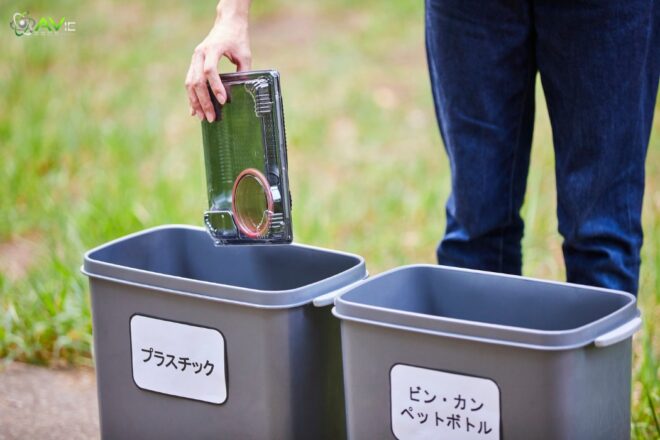
To recover metals, they destroy devices with their hands. They are put at risk for health problems as a result. The proper recycling of e-waste is quite low. In one way or another, much of it is harmful. People can better appreciate the importance of proper e-waste management when they are aware of what occurs following disposal.
How Recycling E-Waste Works
E-waste is recycled in a precise way that protects both people and the environment. E-waste is collected from homes, workplaces, and collection locations. Sorting comes next. Smaller things can be distinguished from larger ones. The correct removal of devices comes next. Useful components are removed. Metals are removed with specialized equipment.
Toxic materials are handled in a way that doesn’t harm the environment. Additionally, plastic parts are recycled. Both personnel and equipment are needed for this. You shouldn’t do this at home. People learn to trust the technique via its use. This also provides justifications for why e-waste shouldn’t be transferred to third parties.
What Individuals Can Do About E-Waste
One way to reduce e-waste is through personal efforts. Using devices for a long amount of time is the first step. Avoid updating devices because of fashion shifts. Repairing devices is preferable to throwing them away and buying new ones. Give useful devices to people in need. Put devices up for sale rather than throwing them away.
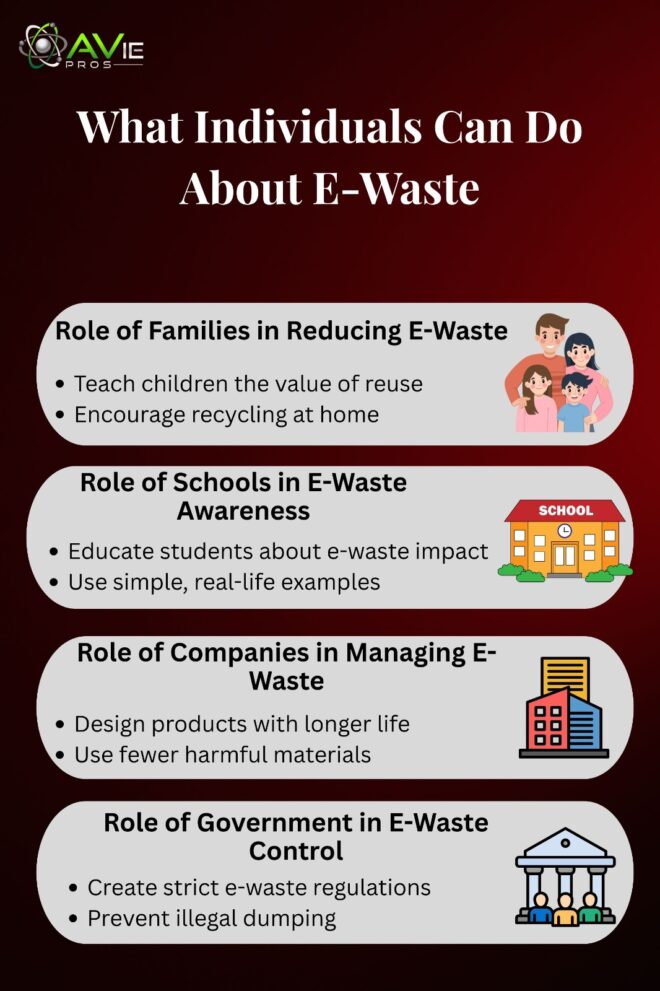
It is important to look for e-waste recycling facilities in your community. Devices should never be thrown out with regular garbage. Understanding the right disposal methods that are available locally is important. Every person can have a big impact on reducing e-waste, which helps maintain a healthy environment for everyone in a neighbourhood or area. Let’s see what others can do:
1. Role of Families in Reducing E-Waste
One of the major factors that may affect e-waste habits is the family. Children can learn the value of e-waste from their parents. The lifespan of equipment can also be extended by establishing rules about its use. Another important factor is that families should share devices instead of buying new ones for each member.
Keeping chargers and accessories organized can also help prevent them from breaking or disappearing. Families can investigate possibilities for fixing a device when they discover that it has stopped functioning. Families can choose equipment that recycles waste, and teaching kids about recycling is another important issue.
2. Role of Schools Can Do About E-Waste
The best location to raise awareness about e-waste is in schools. The effect of electronic waste on the environment can be explained to the children. Both the explanations and the lessons must be simple and supported by real-world examples. Students and their families can participate in an e-waste collection effort organized by the schools. They assist in preventing electronic waste from ending up in landfills and other disposal locations.
Teachers can urge pupils to use technology properly. Repair seminars that show how things can be fixed can also be introduced. Schools can work with recycling firms to dispose of these chemicals safely. Schools are contributing to the development of a future generation that will act on sustainability by teaching young people. Raising awareness from an early age indeed leads to long-term improvements.
3. Role of Companies in Managing E-Waste
Companies that make electronics maintain higher duties in the management of e-waste. They can create goods that are easier to fix and repurpose or that have a longer lifetime. The recycling process would be safer if they used fewer dangerous substances in their manufacturing. To guarantee appropriate recycling, businesses might also provide take-back programs for outdated electronics. Clear instructions for disposal need to be supplied to customers.
By reusing some parts, this would enable businesses to reduce the amount of garbage they produce. Corporate responsibility benefits the environment and fosters trust. Because they manufacture millions of products, companies that take action have a considerably greater influence. Encouraging sustainable practices is good for the business and the environment. Responsible businesses contribute to a cleaner future by lowering pollution.
4. Role of Government in E-Waste Control
Governments are also actively involved in the management of e-waste. They can create regulations to direct recycling and safe disposal. Regulations can limit risky handling and illegal dumping. The government can provide funding and training for recycling facilities. Campaigns are used to raise public awareness of e-waste. E-waste imports and exports need to be closely watched.
Incentives should be provided to businesses that adopt sustainable methods. Better results are obtained when policies are appropriately enforced. The whole system comes together if the government takes strict action. Together, public and private efforts will minimize waste. Strong leadership and regulations are necessary for protecting the environment and public health.
Problems in E-Waste Management
E-waste is challenging to handle. The public’s lack of awareness is the biggest issue. People don’t know where to recycle electronic goods in the majority of urban areas. Recycling facilities are limited and inaccessible in many locations. This encourages people to use illegal recyclers, harming both the environment and human health. The high expense of appropriate recycling is another problem.
Another major issue is the illegal export of e-waste. It is made worse by the insufficient law enforcement. Additionally, technology advances more quickly than any recycling method can. Every problem slows advancement. Finding solutions is made simpler by recognizing issues such as these. Improved investment, knowledge, and planning may reduce these problems.
E-Waste in Developing Countries
E-waste-related issues are also affecting developing countries. The majority of these nations import electronic trash from other nations. There are no safety precautions taken when processing the e-waste. In order to gather valuable items, people are allowed to operate in such dangerous conditions. Weak laws exist, or they are simply ignored.
Recycling is dangerous due to a lack of technology. The majority of those affected are those who live close to garbage. Children typically come into contact with harmful chemicals. With all of these challenges, developing countries also have opportunities. Better systems can be built with assistance to successfully solve these problems.
How Repair and Reuse Works?
Let’s have a quick look on how these cultures change the perspective:
1. Repair Culture
The most important part in the fight against e-waste is a repair culture. Instead of throwing away broken objects, people should fix them. Repairing reduces waste and saves money. Additionally, energy and resources are saved. The majority of problems are simple to fix and don’t need much effort. People become more independent when they learn how to fix things.
Additionally, repair centres offer job possibilities in local areas. Product suppliers must make repairs easier by supplying replacement parts. There is less device waste when a repair culture is introduced. Changing opinions may be very helpful in the fight against e-waste. Adopting a repair culture helps people value their belongings.
2. Reuse and Donation of Electronics
Finding recycling is another method of handling e-waste. The truth is that when people stop using the devices, they are still operational. One efficient option to help those who are unable to purchase the devices is to donate them. The devices are typically given away for free to community organizations, schools, and charities.
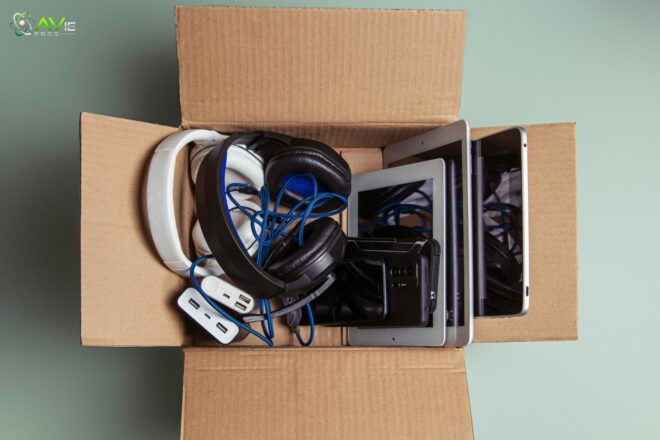
Devices last longer when they are reused. Additionally, the energy required to create new devices is saved. Private information on the devices one plans to gift must be deleted. Reuse is a powerful tool for creating a feeling of community. It is important to build strong communities. Due to people’s dependence on reuse, there will be less demand for new devices. This is the most effective method for affecting society.
How Technology Can Help Reduce E-Waste?
The e-waste issue can be resolved with the help of technology. Through careful design, technology can guarantee the durability of devices. Modular technology facilitates the replacement and repair of physical components. Device usage can be enhanced by software. Monitoring systems can improve recycling performance. Recycling equipment can help ensure that materials are disposed of properly. People can find recyclers with the help of technology.
Innovative recycling techniques can reduce pollution with the use of technology. Apps and online campaigns are two ways that technology may raise awareness of the issue. Instead of producing more e-waste, technology can guarantee the effective use of resources to stop the creation of new waste. When innovation focuses on sustainable objectives, the positive use of technology can produce amazing results.
Importance of Consumer Awareness and Responsible Buying
E-waste is greatly influenced by customer behavior. Reducing e-waste can be achieved by purchasing fewer devices. Choosing long-lasting, high-quality devices is also important. Customers need to think about looking for producers who put recycling first. Upgrades that are not necessary should be avoided. This is a successful strategy for reducing demand. Maintaining devices is another aspect of ethical consumption.
Customers should think about safely charging their devices. This is a successful strategy for encouraging ethical consumption. Customers are positively impacted by this as well. Manufacturers will supply eco-friendly equipment if customers demand it. A manufacturer’s actions are influenced by a single customer. Well-informed consumers can have major advantages.
Importance of E -Waste Recycling
One of the best strategies to address this issue is recycling electronic waste. This allows for the recycling of valuable resources, which may then be put to new uses. There is less need to take products out of the earth, because this mining process damages the planet and uses a lot of energy.
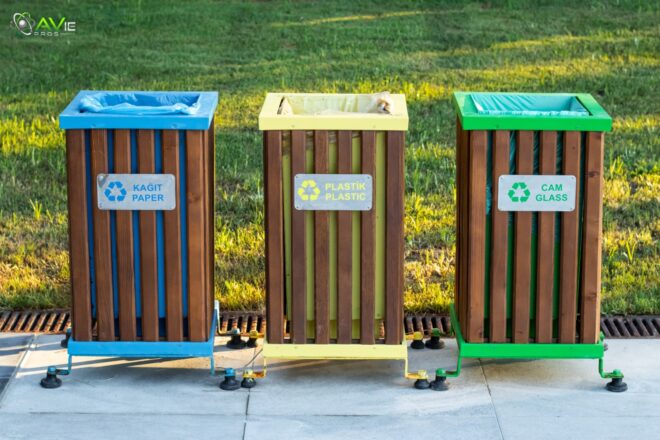
Moreover, recycling reduces the number of toxic substances released into the environment and, when done properly, is a far cleaner way to handle waste. Additionally, it saves energy that would have been used to create new items from the beginning and creates work opportunities within an economy. In actuality, a lot of people think recycling is hard, but it’s getting easier over time.
Future of E-Waste Management
What we do now will impact how e-waste is managed in the future. Better laws and technology will guarantee that e-waste is managed more effectively. The public’s level of education will keep rising. Businesses will start using eco-friendly procedures. People will be able to alter their habits through education.
Global collaboration will guarantee a decline in illegal disposal. Technology will guarantee that the recycling process is improved. Ensuring the existence of a circular economy is the goal here. Products are recycled, repaired, and reused in a circular economy. Waste is minimized as much as possible.
Conclusion
E-waste is a major issue that affects both our health and the environment. Common electronic products that are later destroyed are used in their production. People will be better able to really understand the issue if they are aware of what e-waste is. Repairing, reusing, and recycling electronic devices.
As well as purchasing e-waste-free products, there are some methods to reduce e-waste. It’s time for everyone to work for a cleaner planet and a brighter future for our families, organizations, and our government. Nobody knows what can be achieved if everyone takes care of our only home, the earth, and makes sure it stays clean and secure for life.
FAQs
What is E Waste?
E-waste means electronic waste. It includes old or broken electronic items. These items are no longer used. Phones, laptops, and TVs are common examples.
Why is E-Waste Harmful?
E-waste is harmful because it has toxic materials. These materials damage soil, air, and water. They can also harm human health.
Can E Waste Be Recycled?
Yes, e-waste can be recycled. Recycling helps reuse materials. It also reduces pollution and saves natural resources.
How Can People Reduce E-Waste?
People can reduce e-waste by using devices longer. Repairing and donating also helps. Recycling is very important.
Should E-Waste Go in Normal Trash?
No e-waste should go in normal trash. It needs special handling. Proper disposal keeps people and the environment safe.