When you type a random keyword on different search engines like Google, have you ever thought about how some websites show up on the first page of SERP while others are hidden on page 4 or 5? That’s the power of SEO, or search engine optimization. For a beginner, on page, off page and technical SEO can create confusion and challenges. But, trust me, it’s not complicated at all, especially as we move into 2025.
So, if you’re a freelancer, blogger, small business owner, startup founder, marketer, or even just getting started with a website, this guide is simply for you. We’ll explain the basics of SEO step-by-step in a language that is easy to understand. No techy or complex talk. To get your website found online, it is just a real, small help. Let’s get straight in!
What Is SEO? (Search Engine Optimization Explained)
SEO stands for “Search Engine Optimization.” It is a process where you rank a website naturally on different search engines, particularly Google, by applying various strategies. In other words, a simple way to make your website visible in search results when people look for things related to your business.
Let’s clear the concept with an example. Suppose you are the owner of a coffee shop in Chicago. When someone types ‘best coffee shop near me’ in Google or another search engine, your shop must appear in the query results.
That’s only possible when you do SEO work. With this method, both the search engines and users find it easy to understand your website.
Why does SEO matter?
With thousands of websites being created every day, SEO is extremely crucial to adopt if you want to stand out among the competition. If done right, here’s how SEO can help your website:
- Rather than spending on paid ads, SEO brings more people to your site in a conventional way.
- Creating useful and value-added content builds trust among visitors.
- Your visibility improves in search results.
- With time, it brings steady traffic.
How Do Search Engines Rank Content?
Search engines like Google scan websites with their bots, called ‘crawlers,’ to look for helpful, high-quality, clear, and trustworthy content. If the site meets the criteria, you will surely get an upgrade in the rankings. Some specific things they look at while website scanning:
- Total number of words on the page
- Page speed
- Backlinks from other trusted authority sites
- How easy to use the site on different devices like a phone or tablet?
- UI/UX
To rank higher on the results page, your content must tick all the right boxes.
Types of SEO Every Beginner Should Know
Now that you have a brief introduction to what exactly SEO is, it’s important to understand the different types of SEO you can do on a website. For an SEO lover, particularly a beginner, having a strong and deep knowledge of these SEO types is a key part if you want to master this skill.
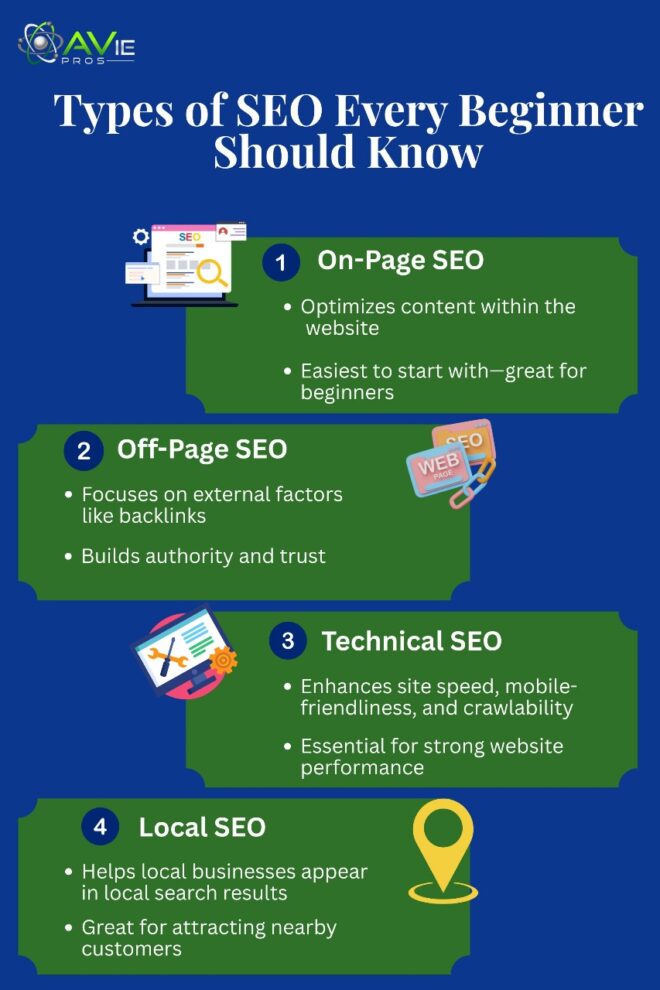
There are four main types of SEO, and you can think of each one of them as a tool in your toolkit. The types are as follows:
- On-Page SEO: On-page, or some say on-site SEO, is the first thing you do when optimizing a website. For better understanding, all the work done inside the website is called on-page SEO. It is probably the easiest type of SEO among the four types. Even a person with less information about search engine optimization can still do all the tasks related to on-page SEO.
- Off-page SEO: Off-page SEO is the opposite of on-page SEO. It is simply what happens outside the website, like getting strong, trusted, and authoritative links from other websites. Many SEO pundits considered off-page SEO the toughest among all other types. So, for a newbie to become a good SEO expert, it’s crucial to have a firm grip on this one.
- Technical SEO: Technical SEO is the foundation of a strong website. It is related to all the stuff that takes place behind the scenes. For example, making sure your site loads fast and works equally well on different devices. There are many other technical aspects linked to this SEO type, so it’s a must to have a strong base in this variation of SEO.
- Local SEO: As the name suggests, this is the type of SEO that is mostly considered for local businesses. By doing local SEO, you help people find you nearby easily. As an SEO professional, it’s another important skill to have in your repertoire.
Let’s explore all four types of SEO in detail.
What Is On-Page SEO? (And How to Do It Right)
Everything that is on your website’s pages is about on-page SEO. To rank better on search engines, you can have full control of your website, which in a way is a big advantage. The main focus of on-site SEO is to make the content understandable both for users and search engines.
There are several factors involved in doing on-page SEO of a website. Here’s how to make it work in the right way:
Use the Right Keywords
Keywords are words or phrases that users search for by typing into a search engine like Google. It may be a question or simply a random text just to get information on that specific query. For example, “best pizza in Brooklyn,” or where can I find the best pizza restaurant in Brooklyn?”
On-page SEO is all about content optimization. Your written content must meet the guidelines set by Google. The first step while optimizing your content is to optimize the keywords. Gone are the days when you can rank a keyword by mentioning it 12 or 13 times in the content. Google hates keyword stuffing and can penalize your website for violating it. So, it’s a must that you add the keywords strategically and naturally in your:
- Headings
- First paragraph (Introduction)
- Conclusion
- URL
- Meta Title & Description
In doing so, search engines will get to know what your page is all about.
Write Helpful and Clear Content
Google loves value-added content. One that is of high quality, clear, simple, useful, and straight to the point. Great on-page content provides answers to the user’s questions and, more importantly, meets the criteria set by search engines.

While writing content, make sure that there are no technical or complex words involved so that even an 8th-class student can find it easy to read and understand. With good content, users get engaged with your website, which improves the user experience, one of the key ranking factors that search engines love.
Optimize Headings and Structure
A page with good content is of no use if it doesn’t have a proper structure and optimized headings. With proper heading tags H1, H2, and H3 utilized throughout the page, users find it helpful to scan the content and make themselves engaged. Make sure to break up the text with proper headings.
Use Internal Links
Internal linking is connecting pages of the same website. Another task while doing on-page SEO is to link those pages that are low-performing to high-performing pages. When done right, internal linking allows users to stick to your website for much longer, and it will help in reducing the website’s bounce rate. It will also be helpful for search engine crawlers to find more of your content easily.
Don’t Forget Images
With content optimization, you can rank content on search engines. Similarly, by doing image optimization, there are chances of appearing in image searches. Visuals added to your written content make it more fun for users to read.
Start by saving the image with a descriptive file name like sublimated-customized-basketball-shorts.jpeg and not just image.jpeg. Search engine crawlers don’t read images, so to describe an image, it’s important to add helpful ‘alt text’. You can include the keyword in the image alt text for better SEO accessibility.
All in all, with solid on-page SEO, you can make the site useful, clear, and easy to find for search engines. It will bring more traffic to your website and keep the users there.
What Is Off-Page SEO?
To help your site show up better on search engines like Google, all the important stuff you do outside of the website is off-page SEO. When it comes to this particular SEO type, it’s all about indicating to search engines that other people trust this website, too.
Here are some easy examples to break it down further:
1. Backlinks: Other Sites Talking About You
When your website gets a strong link from another trusted and authoritative website, that is called a backlink. Another way to say, it’s like getting a vote of confidence or a shout-out from your friend. With many high authority websites linking back to you, search engines get a clear signal about your site’s popularity, reliability, trust, and authority in a particular niche.

Example: Your recipe page gets a link from a famous food blog; that’s a backlink. It certainly boosts your page’s ranking.
2. Social Media Shares: Getting Attention Online
When your website content gets shared on different social media platforms like Facebook, LinkedIn, Twitter, and Instagram, it clearly shows that readers find it useful. According to Google, these social shares aren’t direct ranking factors, but they still help increase the visibility of your website.
Example: One of your blog posts was shared by someone on Facebook, and then it started getting clicks from their friends. Traffic and trust both build.
3. Online Reviews and Brand Mentions
Another way of making your website prominent outside your space is by getting reviews from different sites like Google Reviews, Yelp, or TripAdvisor. Genuine and authentic opinions from these reputable sites help build trust about your business, both in the eyes of people and, most importantly, search engines.
Even though, like social shares, these reviews don’t have a direct impact on rankings, your brand gets talked about and is noticed by search engines.
Example: Your bakery receives a great review from a customer on Google. That helps in improving your local SEO and a strong brand reputation.
4. Guest Posts: Writing for Other Sites
Many considered guest posting the best strategy to obtain natural backlinks. Writing useful and value-added articles for other websites and then including a link back to your site is what you call guest posting. With this strategy, people can find you easily, which ultimately increases your website traffic.
What Is Technical SEO? (Beginner’s Breakdown)
To help search engines (Google, Bing, etc) find, read, and understand your website, technical SEO plays a crucial role. In making your site work better and load faster, all the work is done behind the curtain using this SEO type. Let’s take a look at it in simple steps:
1. Site Speed: Fast Websites Rank Better
Site speed is one of the key website ranking factors for all search engines. If your website is slow, people leave it’s as simple as that. So, to keep your visitors happy, reduce bounce rate, and need a ranking boost, a fast-loading website is a must.
Example: Many users might click away if your page’s loading time is more than 3 seconds. Both your traffic and SEO get affected badly.
2. Mobile-Friendly
More than 90% of websites are opening on mobile phones nowadays. Therefore, it’s highly important that on mobile devices your website looks good and runs smoothly.
Example: If someone can’t unable to read or click the buttons while visiting your website from a mobile, they’ll leave quickly, and search engines will not take that as a good sign.
3. Secure Website: Use HTTPS
All search engines, especially Google, consider HTTPS as a clear ranking factor for a website. It protects your visitors if you have a secure connection (HTTPS). It’s also a big plus from SEO since Google prefers secure websites.

Example: Having a lock icon in the browser indicates that your site uses HTTPS, which makes it safe to visit for both users and search engines.
4. Clean URLs: Easy for Search Engines to Read
URLs are the direct links to access your pages. To help search engines understand what the page is all about, you need to have simple and clear URLs. It’s even better to include the keyword in your URLs.
Example: So instead of using yourwebsite.com/page123?item=456, write the link like yourwebsite.com/dog-toys.
5. Sitemaps and Crawling: Helping Google Find Your Pages
To help Google find your website pages, you need to submit a sitemap. It’s like a structural path that tells search engines what to crawl and index on your site.
Example: In case of no sitemap, your pages might not show up in search results as Google might miss some of them to crawl and index.
Despite sounding complicated, technical SEO is about making sure your site is user-friendly, safe, and fast.
What Is Local SEO? (For Small Businesses & Freelancers)
To help people find your business nearby when they search online, local SEO is the way to go. Freelancers, shops, and service providers who want to show up in local search results find it perfect to use this type of SEO.
Let’s take a step-by-step look at how it works to show up in local searches:
1. Google Business Profile
One of the best things you can do while doing local business is to set up a Google Business Profile (formerly Google My Business). It provides Google with complete information about your name, what you do, and where you’re located.
Example: If your profile is set up and someone types “coffee shop near me,” there’s a possibility your cafe might show up at the top of the list with images, reviews, and directions.
2. Local Keywords: Say Where You Are
On your website, make sure to use location-based keywords so that people know where you’re based. Your site will pop up when searches include your city, town, or neighborhood.
Example: It would be best to say “plumber in Austin” or “affordable plumber near downtown Austin” instead of just saying “plumber.”
3. Local Listings: Be Seen Everywhere
Bing Places, Yellow Pages, or industry-specific sites are some other local directories where you could add your business. Ensure that your name, address, and phone number (NAP) are the same everywhere.
Example: Search engines and potential customers can get confused if you provide different business information on different sites.
In short, to attract nearby customers and to stand out in your area, local SEO helps in that regard. It is one of the smartest ways to grow online if you’re a freelancer or a small business owner.
How to do SEO for your Website? (Step-by-Step)
After explaining all four types of SEO, the next step is to implement all these strategies on your website. Getting all the knowledge about SEO is a good thing, but it’s of no use if there is no implementation. So, the best practice, especially for a beginner to get a solid grip on SEO, is to employ it on your website.
Following is a simple step-by-step plan to get started, and the best thing about this guide is that anyone can follow it easily:
1. Find the Right Keywords
Keyword research is the cornerstone of a successful SEO strategy. You can rank any website based on good keywords. For a start, you can use Google with its autosuggestion feature to find words that people search for when looking for a product or service. If you want to dig deep, there are also paid tools available like Ahrefs, Semrush, etc, that help in finding high-potential keywords.
Example: In case your product is handmade soap, “natural soap for dry skin” can be a good keyword.
2. Add Keywords to Key Places
Once you are done with keyword findings, place them strategically and naturally in the right spots on your website. Page titles, headings, URLs, first and last few lines of your content are the best places to use your keywords.
Example: Your page title “Best Natural Soap for Dry Skin,” the right SEO approach is to use this phrase throughout the content naturally.
3. Write Helpful Content
Answering users’ questions in your content is what Google simply loves. Make sure to write for people first and then for search engines. Your pages, blog posts, or articles should be clear, simple, and easy to read.
Example: “How to use natural soap” is the keyword that someone searches, so to match the search intent, you must write a step-by-step short guide on that topic.
4. Make Your Site Easy to Use
Users must have a good experience while visiting your website. Therefore, ensure that the site has a simple, clean, and easy-to-use layout. Always use mobile-friendly designs, fast-loading pages, and clear menus.
Example: Keep checking your site on a smartphone. Readers (and Google) might leave if it’s too hard to read or slow while loading.
5. Get Backlinks from Other Sites
Google considers your site trustworthy when you get links from other websites. Blogs, news sites, forums, business directories etc are some of the places to obtain natural backlinks.
Example: To review your product, ask a local blogger and include a link to your site.
6. Set Up Google Business Profile (for Local SEO)
Claim your Google Business Profile if you run a local business which makes you visible on Google maps and on local searches.
Example: Your hair salon business should appear with reviews and directions if someone nearby searches ‘’hair salon near me.”
7. Track Your Results
To monitor your site performance, use free tools like Google Search Console and Google Analytics. Keep a close eye on your daily visits, top pages, and what people are searching for.
Example: If you find users regularly visiting one blog post, publish more content like it.
With these steps in focus, SEO doesn’t have to be hard at all. You’ll start to observe more traffic and better rankings once you stay consistent and implement these steps.
Final Thoughts
It might seem big and scary, but finding your website is what SEO is all about. No need to start with a bang. Take small steps. Write quality, helpful content. Use clear, attractive titles. Fast loading. Ensure your site works well on mobiles. Share your stuff and always keep learning.
A big change can happen in SEO even with a few small changes and for that, you don’t need to be a tech expert. Just start rolling things and especially after reading this convincing guide, you’re already ahead of the game.
Once you remain consistent and implement the above-mentioned strategies regularly, you’ll sooner find your site right at the top of search rankings. Remember, SEO is a marathon, not a sprint. Happy optimizing!